
A month end close is the set of steps your accounting team follows after each month ends to make sure every transaction is recorded, every account is reconciled, and your financial statements are accurate. For contractors, a solid month end close also means job costs are complete, the WIP schedule is updated, and over and under billings are booked.
Without a repeatable process, month-end turns into a scramble: missing receipts, unreconciled bank accounts, job reports nobody trusts. This guide gives you a complete month end close checklist built for construction companies, a 10-day close calendar, and tips to speed things up without cutting corners.
What Is a Month End Close in Construction?
Every business closes its books monthly, but the construction month end close has extra layers. You are not just matching bank activity; you are measuring progress on every open job, accruing labor and subcontractor costs, updating estimates to complete, and converting billings into earned revenue.
The goal is simple: by about day 10 of the next month, the owner should have a profit and loss statement, balance sheet, job profitability report and WIP schedule that tell the true story of the business.
Why a Consistent Month End Close Matters
- Catch job problems early: profit fade shows up in month two, not at job closeout.
- Better cash management: clean AR and AP aging reports show exactly what is coming in and going out.
- Bonding and bank confidence: sureties and lenders want timely, consistent monthly financials.
- Faster year-end: if every month is closed properly, year-end and tax prep take days instead of weeks.
- Fewer surprises: payroll tax, sales tax and compliance deadlines are tracked every month.
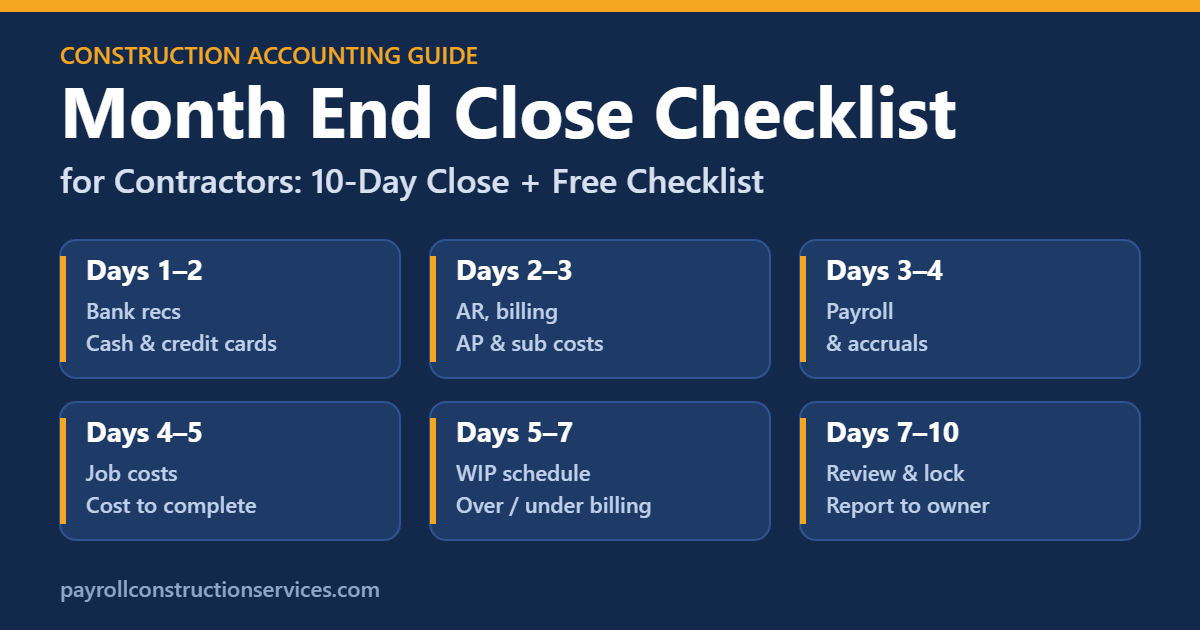
Month End Close Timeline for Contractors
| Day | Focus | Owner |
|---|---|---|
| Last week of month | Pre-close prep: chase receipts, approve timesheets, confirm billing | Bookkeeper, PMs |
| Day 1–2 | Bank and credit card reconciliations; reverse prior accruals | Bookkeeper |
| Day 2–3 | AR and progress billing review; AP and subcontractor cutoff | Bookkeeper, AR/AP |
| Day 3–4 | Payroll review and payroll accruals | Payroll, Bookkeeper |
| Day 4–5 | Job cost review and cost-to-complete updates | PMs, Controller |
| Day 5–7 | WIP schedule, over/under billings and other adjusting entries | Controller |
| Day 7–8 | Balance sheet reconciliations and review | Controller |
| Day 9–10 | Financial statements, owner review, lock the period | Owner, Controller |
The Complete Month End Close Checklist
1. Pre-Close Prep (Last Week of the Month)
- Remind field staff to submit receipts, fuel cards and expense reports.
- Get foremen to approve all timesheets through the last day of the month.
- Confirm which progress billings will go out and when.
- Ask PMs for change orders approved during the month.
- Request subcontractor pay apps and lien waivers due this period.
2. Cash and Bank Reconciliations
- Reconcile every bank account, including payroll and money market accounts.
- Reconcile business credit cards and fuel cards; code each charge to a job or overhead.
- Review uncleared checks older than 90 days.
- Record bank fees, interest income and loan payments.
- Reconcile any line of credit and equipment loan balances to lender statements.
3. Accounts Receivable and Billing
- Confirm all progress billings and T&M invoices for the month are sent and posted.
- Bill approved change orders.
- Record retainage receivable separately from regular AR.
- Review the AR aging; follow up on items over 60 days.
- Review the allowance for doubtful accounts.
Tighter billing and collections make every close easier. See our guide to construction accounts receivable for proven best practices.
4. Accounts Payable and Subcontractors
- Enter all vendor bills dated in the month, coded to the right job and cost code.
- Set a clear cutoff: work done or materials delivered by month-end belongs to this month.
- Record retainage payable on subcontractor bills.
- Collect lien waivers before releasing sub payments.
- Check subcontractor certificates of insurance and W-9s for upcoming 1099s.
- Review the AP aging for duplicates and old open items.
5. Payroll
- Reconcile payroll registers to the general ledger: gross wages, taxes and net pay.
- Confirm federal and state payroll tax deposits were made on time and match the liability accounts.
- Reconcile union fringe and benefit remittances.
- Submit certified payroll reports for prevailing wage jobs.
- Book the accrued payroll journal entry for unpaid days, including labor burden.
Quarterly, make sure your liability balances tie to Form 941 and state wage reports. If you run prevailing wage jobs, our certified payroll services can handle the weekly reports for you.
6. Job Costing
- Run a job cost report for every open job and look for miscoded costs.
- Confirm equipment usage and internal equipment charges are posted to jobs.
- Allocate overhead to jobs using your predetermined overhead rate, if you apply overhead.
- Have each PM update total estimated cost and cost to complete.
- Update contract values for approved change orders.
7. Accruals and Adjusting Entries
- Reverse last month’s accruals on day one (see our guide to reversing entries).
- Accrue subcontractor and supplier costs for work done but not invoiced.
- Accrue unbilled T&M revenue.
- Amortize prepaid insurance, bonds and permits.
- Record depreciation on equipment, vehicles and tools.
- Accrue interest, utilities, equipment rentals and other expenses billed in arrears.
Our full guide to adjusting entries for contractors walks through each of these with journal entry examples.
8. WIP Schedule and Revenue Recognition
- Build the WIP schedule from updated contract values, estimated costs, costs to date and billings.
- Calculate percent complete and earned revenue for each job.
- Book over and under billings (see over billing vs. under billing).
- Record a full loss provision on any job now expected to lose money.
- Tie WIP totals to the balance sheet accounts.
9. Balance Sheet Reconciliations
- Reconcile every balance sheet account to a supporting schedule.
- Fixed assets: tie cost and accumulated depreciation to the fixed asset register.
- Prepaids: tie to the amortization schedule.
- Accrued liabilities: tie to the accrual worksheet.
- Loans and lines of credit: tie to lender statements.
- Clear out suspense, “ask my accountant” and undeposited funds accounts.
- Review owner draws, distributions and shareholder loans.
10. Financial Statements, Review and Lock
- Run the P&L, balance sheet, cash flow summary and job profitability report.
- Compare to last month, the same month last year and the budget; explain large variances.
- Review key ratios: gross margin, working capital, current ratio, days sales outstanding.
- Send the package to the owner and review it together.
- Lock the period in your accounting software so nobody can change closed months.
Key Reports to Review After Every Month End Close
| Report | What to look for |
|---|---|
| Profit and loss | Gross margin trend, overhead as a percent of revenue |
| Balance sheet | Working capital, cash vs. net over billings |
| WIP schedule | Profit fade, large under billings, stalled jobs |
| Job profitability | Jobs below target margin |
| AR aging | Slow-paying customers, unpaid retainage |
| AP aging | Bills at risk of late fees or sub disputes |
| Cash flow forecast | Payroll coverage for the next 4–8 weeks |
Common Month End Close Bottlenecks (and Fixes)
| Bottleneck | Fix |
|---|---|
| Late timesheets from the field | Use mobile time tracking with daily approval |
| Missing receipts | Require photo receipts in a card app within 48 hours |
| PMs slow to update cost to complete | Hold a standing 30-minute WIP meeting on day 5 |
| Subs bill weeks late | Set a pay app cutoff date in subcontracts |
| Too many manual journal entries | Use recurring and auto-reversing entries |
| Books reopened after close | Lock the period and require approval to reopen |
The right construction accounting software can automate many of these steps, from bank feeds to WIP reports.
How to Shorten Your Month End Close
- Do work during the month. Reconcile bank feeds weekly instead of all at once.
- Standardize accruals. Use the same worksheet every month for payroll, subs and rentals.
- Automate recurring entries. Depreciation and prepaids can be set up once a year.
- Set deadlines for PMs and the field. Put the close calendar on everyone’s schedule.
- Use a checklist like this one, with a name and due date next to every task.
- Review, then improve. After each close, note what caused delays and fix one thing.
Month End Close for Small Contractors vs. Growing Companies
A small remodeler with two crews and five open jobs does not need the same month end close as a $30 million general contractor. But the core steps are the same; what changes is the depth and who does the work.
| Company size | Typical close length | What to focus on |
|---|---|---|
| Under $2M revenue | 3–7 days | Bank recs, billing, AP cutoff, payroll accrual, simple job profit report |
| $2M–$10M | 7–12 days | Everything above plus a monthly WIP schedule and balance sheet recs |
| $10M+ | 8–15 days | Full WIP review with PMs, formal variance analysis, board or lender reporting |
Small contractors often skip the WIP schedule until a surety asks for one. Starting it early, even as a simple spreadsheet, builds the history that bonding companies want to see and makes the jump to larger projects much easier.
A Real-World Example: From 25 Days to 8 Days
A commercial concrete contractor with about $8 million in revenue used to finish its month end close around the 25th of the following month. By then, the numbers were too old to act on. The biggest delays were late timesheets, subcontractor bills that arrived weeks after the work, and PMs who updated their estimates only when asked twice.
The company made four changes: mobile time tracking with daily foreman approval, a pay app cutoff on the 25th written into every subcontract, a standing WIP meeting on the fifth business day, and auto-reversing accruals in the accounting system. Within three months the month end close dropped to eight business days. More importantly, the owner caught a fading job in its second month and recovered most of the margin through a change order that had never been billed.
Month End Close vs. Year End Close
The year end close includes every step of a normal month end close plus a few extras:
- Physical count of materials inventory, if you carry any.
- Review of fixed asset additions and disposals for the year, and tax depreciation.
- Final review of accrued bonuses, PTO and other year-end payroll items.
- 1099 preparation for subcontractors and W-2 preparation for employees.
- Closing entries that move income and expense into retained earnings.
- A full package for your CPA, including the WIP schedule and closed jobs schedule.
If you have closed every month properly, year-end becomes a short extra list instead of a giant cleanup project. Our contractor tax prep team works from your December close to file on time.
Who Owns Each Step?
A month end close works best when every task has one owner and one due date. In most construction companies the roles look like this:
- Foremen and superintendents: approve timesheets, report work completed and materials received.
- Project managers: update cost to complete, change orders and billing status.
- AP and AR clerks: enter bills, invoices, lien waivers and retainage.
- Payroll administrator: run payroll, reconcile taxes and file certified payroll.
- Bookkeeper or controller: reconcile accounts, post accruals, build the WIP schedule and prepare statements.
- Owner: review the results, ask questions and make decisions.
If you do not have a full-time controller, an outsourced construction accountant can run the whole month end close for you and deliver the reports on a set date every month.
Printable Month End Close Checklist (Quick Version)
- Approve timesheets and collect receipts
- Reconcile all bank and credit card accounts
- Post all customer billings, change orders and retainage
- Enter all vendor and subcontractor bills by job
- Reconcile payroll and payroll tax deposits
- Reverse prior accruals
- Accrue payroll, sub costs, unbilled revenue and other expenses
- Record depreciation and amortize prepaids
- Update estimates to complete and contract values
- Build the WIP schedule and book over and under billings
- Reconcile every balance sheet account
- Run and review financial statements and job reports
- Lock the period
Month End Close KPIs to Track
Measuring the month end close itself helps you improve it. Track a few simple numbers every month:
- Days to close: business days from month-end until the owner receives the financial package. Aim for 10 or fewer.
- Number of post-close adjustments: entries made after the period was locked. Fewer is better.
- Unreconciled accounts: balance sheet accounts without a supporting schedule. Target zero.
- Late timesheets and bills: how many came in after the cutoff.
- Estimate accuracy: how close each job’s final profit came to the WIP schedule estimate three months earlier.
Review these KPIs once a quarter with your team. Even small improvements, like getting timesheets one day sooner, can shorten the month end close by several days over a year. A faster, cleaner close means decisions are made on current numbers instead of last month’s guesswork.
Contractors who track these numbers often find the same two or three steps cause most of the delay. Fix those first, and the rest of the month end close checklist usually falls into place.
Tools That Make the Month End Close Easier
You do not need an expensive system to run a strong month end close, but a few tools save hours each month. Bank feeds pull transactions into your accounting software daily, so reconciliations are mostly done before month-end. Receipt capture apps let field staff snap photos of receipts the moment they buy materials. Mobile time tracking gets hours approved by foremen every day instead of every Friday. A shared close checklist in a spreadsheet or project management tool shows who owns each task and what is still open.
Finally, a document storage system for lien waivers, certificates of insurance and subcontractor pay apps keeps support in one place. When your CPA, surety or lender asks a question, the answer is a few clicks away instead of buried in someone’s email inbox. Put together, these tools can cut several days from your month end close without adding staff.
Let Us Run Your Month End Close
Payroll Construction Services handles the full month end close for contractors: reconciliations, payroll accruals, job costing, the WIP schedule and monthly financial statements delivered on a set schedule. Explore our construction bookkeeping and construction accounting services, or contact us for a free review of your current process.
Month End Close FAQs
How long should a month end close take for a contractor?
Most small and mid-size contractors can close in 5 to 10 business days. Larger companies with many jobs may take 10 to 15 days, but faster closes give owners more time to act on the numbers.
What is the most important step in a construction month end close?
Updating cost to complete and building the WIP schedule. It drives earned revenue, over and under billings and job profit, which are the numbers sureties and banks care about most.
Do I need to close the books every month?
Yes, if you want accurate job costs and timely financial statements. Quarterly-only closes make it hard to catch problems while jobs are still running.
What reports come out of the month end close?
At minimum: profit and loss, balance sheet, WIP schedule, job profitability, AR aging and AP aging. Many contractors also review a short-term cash flow forecast.
Should I lock the period after closing?
Yes. Locking closed months prevents changes that would make reports you already shared with your bank or surety incorrect.
Final Thoughts
A reliable month end close is what turns construction bookkeeping into real management information. Follow the same checklist every month, assign owners and deadlines, update job estimates, book your accruals and WIP entries, and lock the period. The result is financial statements you can trust and decisions you can make while jobs are still on track.