
Getting paid on time is one of the hardest parts of running a construction or engineering business. You can win the bid, finish the work on schedule and still run short on cash because invoices sit unpaid for 60 or 90 days. That is why accounts receivable management construction engineering best practices matter so much. Strong construction accounts receivable habits turn finished work into money in the bank faster.
In this guide, we explain in simple English how accounts receivable (AR) works for contractors and engineering firms, why it is harder than in other industries, and 15 proven accounts receivable management construction engineering best practices you can start using this week.
What Is Construction Accounts Receivable Management?
Construction accounts receivable is the money customers owe you for work you have already billed. AR management is the process of billing correctly, tracking what is owed, following up on late payments and recording payments in your books.
In most industries, a business sends one invoice and waits for one payment. Construction and engineering are different. You may send a monthly pay application, hold back retainage until the end of the job, bill change orders separately and wait for the owner to pay the general contractor before the GC pays you.
Following accounts receivable management construction engineering best practices means building a system that handles all of these steps the same way, every month, on every project.
Why Construction Accounts Receivable Is Harder for Contractors and Engineering Firms
Here are the main reasons cash gets stuck in construction accounts receivable:
- Retainage: Owners and GCs often hold back 5% to 10% of each payment until the project is complete. On a large job, that can be a lot of money waiting for months.
- Progress billing: You bill based on percent complete, and every pay application must match the schedule of values and be approved by the owner, architect or engineer.
- Change orders: Extra work is often done before the paperwork is signed, which leads to disputes and late payment.
- Pay-when-paid chains: Subcontractors often wait for the GC, who waits for the owner, who may wait for a lender.
- Strict paperwork: Missing lien waivers, certified payroll reports or insurance certificates can hold up an entire payment.
- Lien deadlines: If you miss a preliminary notice or lien deadline, you can lose one of your strongest tools for getting paid.
The good news is that following accounts receivable management construction engineering best practices prevents most of these problems with a clear, repeatable process.
15 Accounts Receivable Management Construction Engineering Best Practices
1. Set Clear Payment Terms in the Contract
Strong AR starts before the job starts. Your contract should clearly state the billing date, payment due date (for example, net 30), retainage percentage, when retainage will be released, late fees or interest, and what documents must come with each invoice. Clear terms prevent arguments later.
2. Build a Detailed Schedule of Values
The schedule of values (SOV) breaks the contract into line items such as mobilization, site work, concrete, framing and electrical. A detailed SOV makes it easier to show percent complete and harder for the owner to dispute your numbers. Front-load reasonable items like mobilization and materials so your cash flow is not always behind your costs.
3. Learn Each Customer’s Billing Requirements Before the First Invoice
Every owner and GC has its own rules. Ask these questions at the start of the job:
- What is the pay application cut-off date each month?
- Which forms do you require (AIA G702/G703 or your own form)?
- Do you need conditional lien waivers, certified payroll or insurance certificates with each billing?
- Who approves the invoice, and who should we contact about payment status?
Write the answers on a one-page project billing sheet so anyone on your team can bill correctly.
4. Bill On Time, Every Time
The number one cause of slow payment is slow billing. If the pay app deadline is the 25th and you send it on the 28th, you may wait a whole extra month. Create a billing calendar for every active project and treat the deadline like a job site safety rule: it is not optional.
For engineering firms, send invoices on the same day each month, or right after each milestone is reached. Do not let finished work sit unbilled.
5. Use the Correct Pay Application Format
Most commercial projects use the AIA G702 and G703 forms or a similar format. Double-check that your percent complete, stored materials, retainage and previous payments add up. One math error can send the whole pay app back to you and delay payment by weeks.
6. Get Change Orders Signed Before the Work, and Bill Them Fast
Unsigned change orders are one of the biggest sources of unpaid receivables. Whenever possible, get written approval of the scope and price before you start the extra work. Then add approved change orders to your next pay application right away. Keep a change order log for each project with the date, amount, status and approval.
7. Track Retainage Separately
Retainage is a special part of construction accounts receivable: money you have earned but cannot collect yet. If it is mixed in with your regular receivables, it is easy to forget. Use a separate retainage receivable account in QuickBooks or Xero, and keep a list of every project with retainage held, the amount, and the expected release date. When a project reaches substantial completion, send your retainage invoice and closeout documents immediately.
8. Send Preliminary Notices and Protect Your Lien Rights
Mechanic’s lien rights are a powerful way to get paid, but only if you follow your state’s rules. Many states require a preliminary notice early in the job, and lien deadlines vary widely from state to state. Keep a calendar of notice and lien deadlines for every project. Sending notices is normal business practice, not a sign of distrust.
9. Handle Lien Waivers Carefully
A conditional lien waiver only takes effect once your payment actually clears. An unconditional waiver takes effect as soon as you sign it. As a simple rule, send conditional waivers with your pay apps and only sign unconditional waivers after the money is in your bank account.
10. Review the AR Aging Report Every Week
An AR aging report shows who owes you money and for how long, usually in groups such as current, 1–30 days, 31–60 days, 61–90 days and over 90 days. Review it every week, not just at month-end. Look for: Seriously past-due balances may need an allowance for doubtful accounts, one of the adjusting entries every contractor should book at month-end.
- Invoices that are past due
- Customers who are paying slower than before
- Retainage that should already have been released
- Small balances, short payments or unapplied payments that need to be fixed
This weekly review is one of the simplest accounts receivable management construction engineering best practices, and it often has the biggest impact.
11. Follow a Simple Collections Schedule
Do not wait until an invoice is 90 days old to call. Use a friendly, consistent follow-up schedule like this:
| When | Action |
|---|---|
| 5 days before due date | Confirm the invoice was received and approved |
| Due date | Send a short, polite payment reminder |
| 7 days past due | Phone call to the project manager or accounts payable contact |
| 15 days past due | Second call and written reminder with a copy of the invoice |
| 30 days past due | Escalate to the owner or senior manager; review lien deadlines |
| 45–60 days past due | Final notice; consider stopping work if the contract allows, or speak to an attorney |
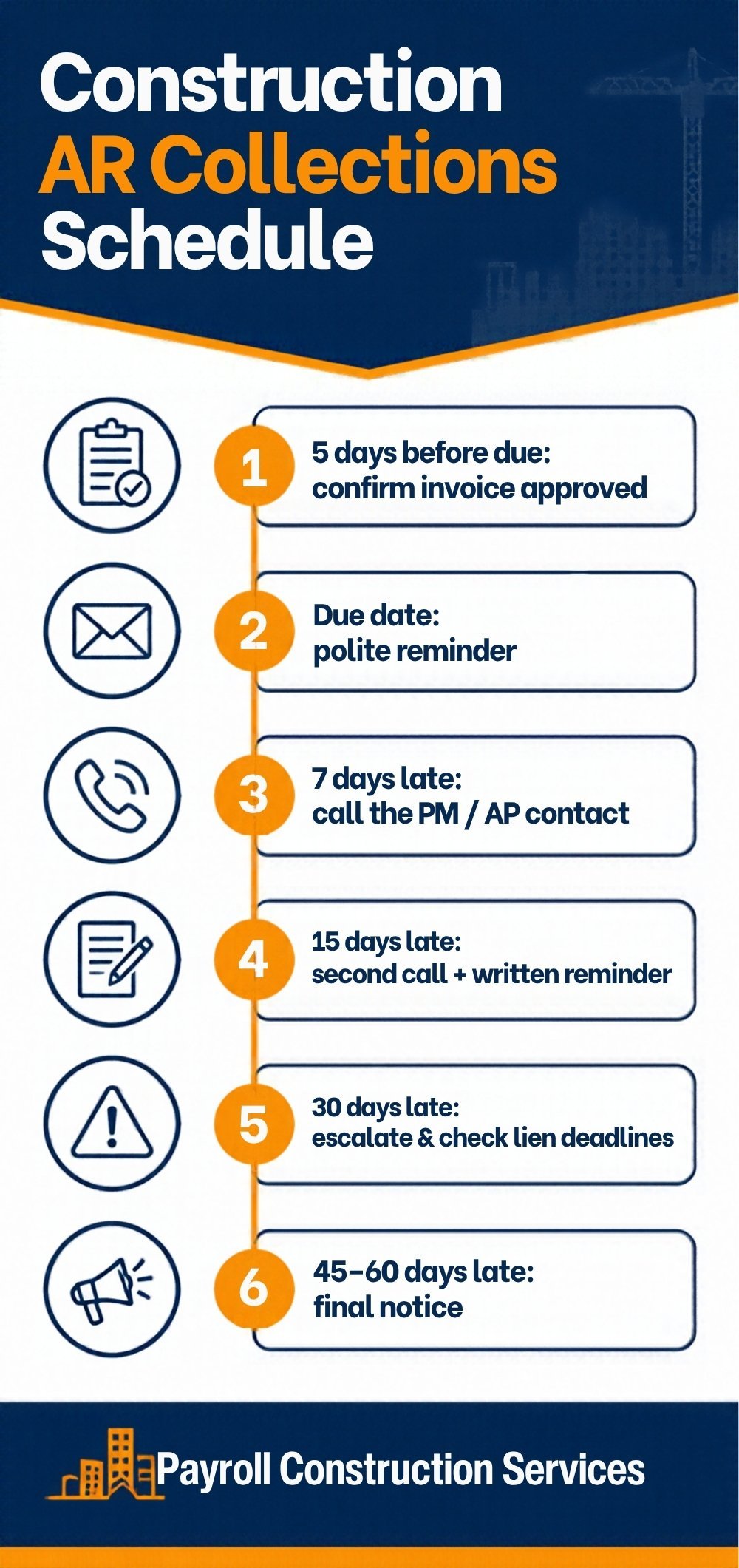
Always keep notes of every call and email. Polite, steady follow-up usually works better than angry calls.
12. Make It Easy for Customers to Pay
Offer ACH bank transfer and online payment links, and accept payments through customer portals when required. The fewer steps a customer must take, the faster you get paid. Make sure your invoice shows your remittance details clearly, and that your W-9 is already on file with each customer.
13. Know the Prompt Payment Rules
On federal projects, the Prompt Payment Act generally requires agencies to pay proper invoices within 30 days or pay interest. Prime contractors on federal jobs must also pay their subcontractors promptly after they get paid. Most states have their own prompt payment laws for public and sometimes private projects. Knowing these rules gives you a stronger, professional position when a payment is late.
14. Engineering Firms: Bill Time and Milestones Without Delay
Engineering and design firms often bill hourly (time and materials), by milestone, or as a percent of a fixed fee. To keep AR healthy:
- Collect timesheets weekly so billable hours are never missed
- Review unbilled work (work in progress) before each billing cycle
- Bill reimbursable expenses in the same cycle as labor
- Get written approval when the scope grows beyond the original fee
Unbilled work is just as dangerous as unpaid invoices, because it is cash you have earned but not yet asked for.
15. Track AR Metrics Every Month
What gets measured gets managed. Track these key numbers every month:
- Days Sales Outstanding (DSO): (Accounts receivable ÷ revenue for the period) × number of days in the period. Lower is better.
- Percent of AR over 60 days: Shows how much of your money is stuck.
- Retainage outstanding: Total retainage owed to you across all projects.
- Collection Effectiveness Index (CEI): (Beginning AR + monthly billings − ending total AR) ÷ (beginning AR + monthly billings − ending current AR) × 100. A score close to 100% means you are collecting well.
Compare these numbers month to month. A rising DSO is an early warning sign of cash flow trouble. Tracking these numbers is also how you know your accounts receivable management construction engineering best practices are actually working.
Example: How Faster Collections Improve Cash Flow
Let’s say a small contractor bills $1,200,000 a year. That is about $3,288 of revenue per day ($1,200,000 ÷ 365).
If the company’s DSO is 75 days, about $246,600 is tied up in receivables. By billing on time and following up consistently, the company brings DSO down to 50 days. Now only about $164,400 is tied up.
That frees up roughly $82,200 in cash, money that can cover payroll, buy materials or help bid larger jobs, without taking a loan. This is why accounts receivable management construction engineering best practices pay off so quickly.
Quick Checklist: Accounts Receivable Management Construction Engineering Best Practices
Print this checklist and keep it next to your desk.
At the start of every job
- Contract states billing date, due date, retainage and late payment terms
- Detailed schedule of values approved
- Customer billing requirements written on a project billing sheet
- Preliminary notice sent and lien deadlines added to the calendar
Every week
- Review the AR aging report
- Follow up on past-due invoices using your collections schedule
- Log new change orders and chase unsigned ones
- Collect timesheets and check for unbilled work
Every month
- Submit pay applications before the cut-off date
- Send conditional lien waivers and other required documents
- Record all payments against the correct invoice and job
- Update the retainage report and calculate DSO and CEI
At project closeout
- Send the retainage invoice and closeout documents right away
- Confirm final change orders are billed
- Sign unconditional final waivers only after payment clears
Common Construction Accounts Receivable Mistakes to Avoid
- Waiting until the end of the month to start preparing pay apps
- Doing extra work on verbal approval only
- Mixing retainage with regular receivables
- Signing unconditional lien waivers before payment clears
- Not recording customer payments against the correct invoice and job
- Letting the project manager and the office have different numbers
- Ignoring small short payments, which add up over many projects
Tools That Make Construction Accounts Receivable Easier
You do not need expensive software to follow accounts receivable management construction engineering best practices, but good tools help:
- Accounting software: QuickBooks Online or Xero with job (project) tracking turned on
- Construction software: Procore, Buildertrend, Sage 100 Contractor or Foundation for pay apps and change orders
- Payment tools: ACH and online payment links connected to your invoices
- Reports: a weekly AR aging report and a monthly retainage report
The most important tool is a clear construction accounts receivable process that someone follows every week.
Construction Accounts Receivable vs. Accounts Payable
Construction accounts receivable and accounts payable are two sides of the same cash flow. Managing both together keeps your company from running short on cash.
| Construction accounts receivable | Construction accounts payable | |
|---|---|---|
| What it is | Money owners and GCs owe you | Money you owe suppliers and subcontractors |
| Retainage | Retainage receivable held by your customer | Retainage payable you hold from your subs |
| Key timing | Pay application cut-off and payment terms | Supplier terms and pay-when-paid clauses |
| Main report | AR aging report | AP aging report |
| Risk if ignored | Cash shortages and bad debt | Late fees, liens and damaged supplier relationships |
A simple rule: try to collect construction accounts receivable faster than you must pay construction accounts payable. When billing is late, you end up financing your customers’ projects with your own cash.
Construction Accounts Receivable for Engineering Firms vs. Contractors
Construction accounts receivable looks a little different for engineering firms. Engineers often bill hourly or by milestone, rarely deal with retainage on small jobs, and wait on client approvals instead of pay applications. Contractors deal with schedules of values, retainage, lien waivers and change orders. Both benefit from the same core habits: bill on time, review aging weekly, follow up consistently and track every unbilled dollar.
How Payroll Construction Services Can Help
At Payroll Construction Services, we handle AR for contractors and engineering firms as part of our monthly service. We follow the same accounts receivable management construction engineering best practices in this guide for every client. We set up job costing and retainage tracking, prepare billing support, review your aging report, record payments correctly and send you clear monthly reports.
If your books are behind or you are not sure who owes you money, our construction bookkeeping services can get your receivables organized. For deeper reporting such as WIP schedules and over/under billing, see our construction accounting services. You can also explore all of our services or contact us for a free consultation.
Frequently Asked Questions
What is a good DSO for a construction company?
It depends on your trade and customers, but many contractors aim to keep DSO under 45 to 60 days. Retainage usually pushes construction DSO higher than in other industries, so track retainage separately to see your true collection speed.
How do you manage retainage receivable?
Record retainage in its own account, keep a list of every project with retainage held, track the release date, and send a retainage invoice with closeout documents as soon as the project reaches substantial completion.
When should a contractor send a preliminary notice?
Rules depend on the state and the type of project. Many states require notice within a set number of days after you first deliver labor or materials. Check your state’s rules at the start of every job and keep a deadline calendar.
What is the difference between a conditional and an unconditional lien waiver?
A conditional waiver only becomes effective once you are actually paid. An unconditional waiver is effective right away, even if the check bounces. Only sign unconditional waivers after the payment has cleared.
What are the most important accounts receivable management construction engineering best practices?
The most important steps are billing on time, getting change orders approved in writing, tracking retainage separately, protecting your lien rights, reviewing your AR aging report every week and following up on late invoices with a consistent schedule.
Final Thoughts
Strong construction accounts receivable is not about luck. It comes from clear contracts, on-time billing, careful paperwork and steady follow-up. Start with the basics: a billing calendar, a weekly aging review and a separate retainage account. Then add the rest of these accounts receivable management construction engineering best practices one step at a time.
Do these steps consistently and you will get paid faster, have fewer disputes and have the cash to grow your construction or engineering business with confidence.
Pingback: Adjusting Entries: 8 Proven Types + Easy Contractor Examples
Pingback: Predetermined Overhead Rate: Formula & 4 Easy Steps (2026)
Pingback: Accrued Payroll Journal Entry: 6 Easy Steps + Proven Examples
Pingback: Construction Accounting Software: 10 Essential Features