
The predetermined overhead rate is the rate a business uses to assign estimated overhead costs to jobs or products. You set it at the start of a period by dividing estimated overhead by an estimated allocation base, such as labor hours or machine hours. Then you apply it to each job as the work happens.
If you run a construction, remodeling or manufacturing business, this one number affects how you price bids, how profitable each job looks, and whether your books close cleanly at year-end. This guide covers the formula, a step-by-step calculation, a full contractor example, journal entries, and how to fix overhead that comes in over or under your estimate.
What Is a Predetermined Overhead Rate?
Overhead is the cost of running the business that you can’t trace directly to one job. Examples are equipment depreciation, shop rent, insurance and a superintendent who oversees several sites. You can’t wait until December to learn what overhead cost each job. You need it when you bid and when you invoice.
The predetermined overhead rate fixes that. You estimate the year’s overhead, pick an activity that drives it (the allocation base), and work out a rate per unit of that activity. Each job then picks up overhead based on how much of that activity it used.
It is called predetermined because both numbers are estimates set before the period starts. At year-end you compare the estimate with actual costs and adjust the difference.
Predetermined Overhead Rate Formula
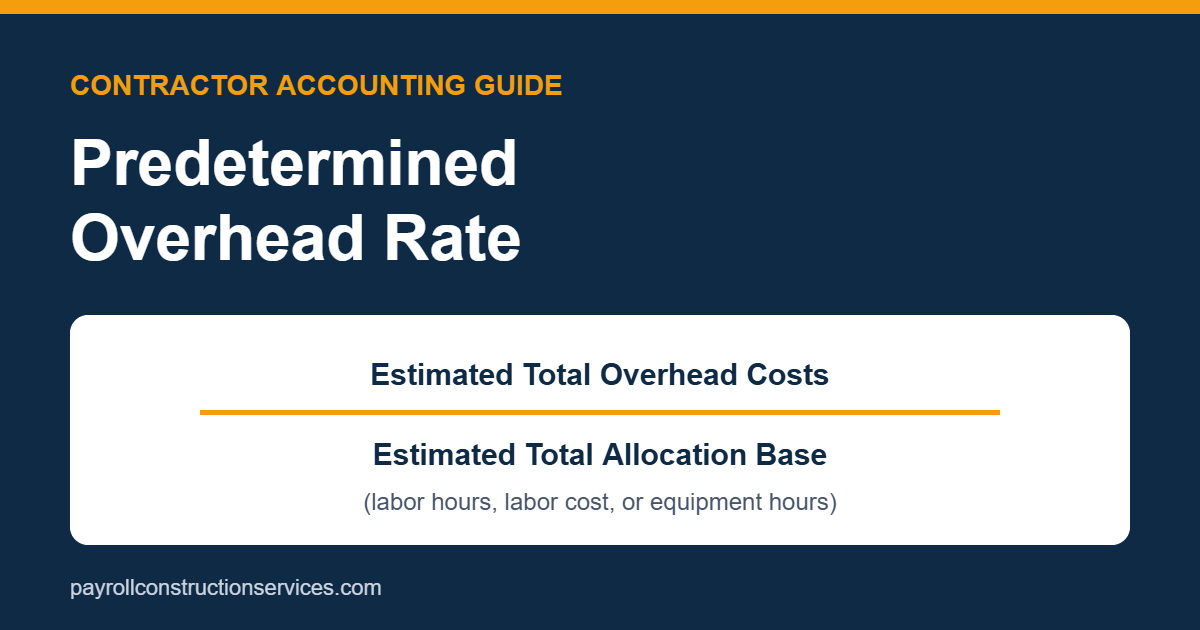
Predetermined overhead rate = Estimated total overhead costs ÷ Estimated total units of the allocation base
Once you have the rate, you use it to apply overhead to each job:
Applied overhead = Predetermined overhead rate × Actual units of the allocation base used
Always state the rate with its base, for example “$13.00 per direct labor hour” or “$50.00 per equipment hour”. A rate with no base attached is meaningless.
What Counts as Overhead (and What Doesn’t)
The most common mistake is putting the wrong costs in the numerator. Use this table as a checklist.
| Cost type | Examples | In the overhead rate? |
|---|---|---|
| Direct materials | Lumber, drywall, tile and fixtures bought for a specific job | No, charge directly to the job |
| Direct labor | Wages and payroll taxes for crew working on a specific job | No, charge directly to the job |
| Indirect job (field) overhead | Equipment depreciation, fuel and repairs, small tools, yard rent, supervisors across jobs, field vehicles, liability insurance | Yes |
| General and administrative (G&A) | Office rent, office staff, accounting, marketing | Usually no; treated as a period expense (many contractors cover it in their bid markup instead) |
How to Calculate the Predetermined Overhead Rate in 4 Steps
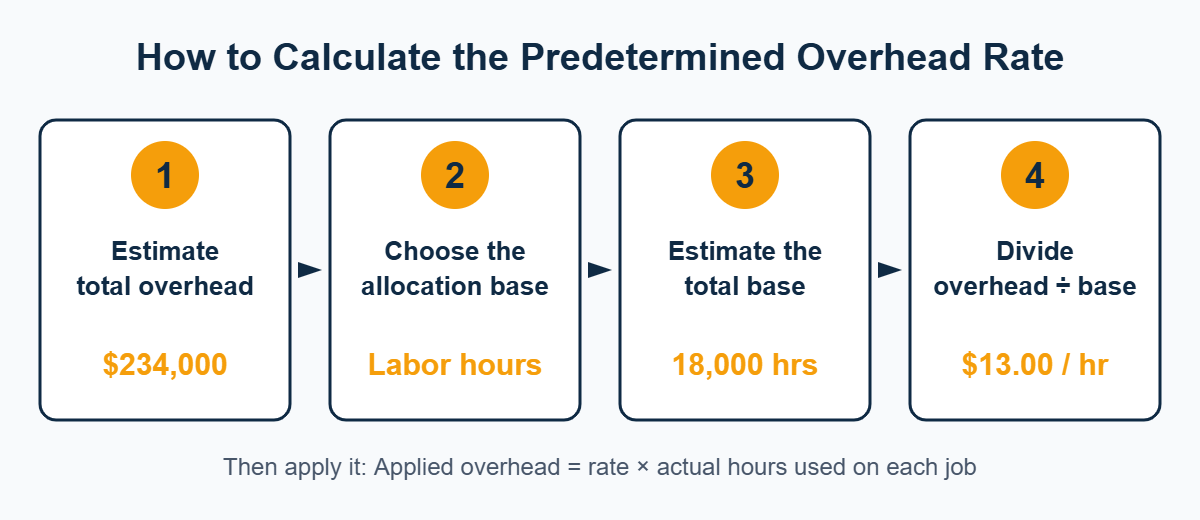
Step 1: Estimate Total Overhead for the Period
Start from last year’s actual indirect costs in your books. Then adjust for known changes, such as a new truck, an insurance renewal or a rent increase. Include only indirect production or field costs (see the table above). Clean, up-to-date construction bookkeeping makes this step much faster.
Step 2: Choose the Allocation Base
Pick the activity that most closely drives your overhead. If your overhead is mostly equipment, use equipment or machine hours. If it is mostly crew-related, use direct labor hours or labor cost.
| Allocation base | Best for | Watch out for |
|---|---|---|
| Direct labor hours | Remodelers, trade contractors, labor-heavy shops | Undercharges equipment-heavy jobs |
| Direct labor cost ($) | Firms with a wide range of pay rates | Jobs with senior crews pick up more overhead even if they don’t use more resources |
| Equipment / machine hours | Excavation, paving, CNC or automated manufacturing | Needs reliable hour tracking on each machine |
| Units produced | Single-product manufacturers | Doesn’t work when products or jobs differ in size |
| Direct materials cost ($) | Material-heavy work where overhead follows purchasing and handling | Price swings in materials distort the rate |
Step 3: Estimate the Total Allocation Base
Forecast how many hours (or dollars, or units) of that base you expect in the period. For labor hours, multiply expected field employees by expected billable hours each. Be realistic. An optimistic forecast makes the rate too low and every bid too cheap.
Step 4: Divide
Divide Step 1 by Step 3. Simple manufacturing example: a shop expects $240,000 of overhead and 12,000 direct labor hours.
$240,000 ÷ 12,000 direct labor hours = $20.00 per direct labor hour
A job that uses 50 labor hours picks up 50 × $20.00 = $1,000 of overhead.
Predetermined Overhead Rate Example: A Remodeling Contractor
Ridgeline Remodeling (a fictional company) does kitchens, baths and additions. Its overhead is mostly crew-driven, so it uses direct labor hours as its base.
Step 1: Estimated Annual Overhead
| Indirect cost | Estimated annual amount |
|---|---|
| Superintendent salary (covers all jobs) | $72,000 |
| Equipment depreciation | $42,000 |
| Shop and yard rent | $36,000 |
| Liability insurance | $27,000 |
| Field vehicles | $24,000 |
| Equipment fuel and repairs | $18,000 |
| Small tools and consumables | $9,000 |
| Field phones and job software | $6,000 |
| Total estimated overhead | $234,000 |
Steps 2–4: Base and Rate
Ridgeline expects 18,000 direct labor hours this year.
$234,000 ÷ 18,000 direct labor hours = $13.00 per direct labor hour
Applying the Rate to a Job
A kitchen remodel takes 420 crew hours at an average loaded wage of $32 per hour.
| Job cost component | Calculation | Amount |
|---|---|---|
| Direct materials | From supplier invoices | $18,500 |
| Direct labor | 420 hrs × $32 | $13,440 |
| Applied overhead | 420 hrs × $13.00 | $5,460 |
| Total job cost | $37,400 | |
| Price at 15% markup | $37,400 × 1.15 | $43,010 |
Without the overhead line, Ridgeline would think this job cost $31,940. A bid built on that number would lose money on every kitchen once rent, insurance and equipment were paid.
Overapplied vs. Underapplied Overhead
Your estimates will never be exactly right. At year-end, compare the overhead you applied to jobs with the overhead you actually spent.
- Overapplied: applied overhead is more than actual. Job costs were overstated slightly.
- Underapplied: applied overhead is less than actual. Job costs were understated, and your bids may have been too low.
Scenario A: a busy year (overapplied). Ridgeline works 19,200 hours and actual overhead is $246,500.
- Applied: 19,200 × $13.00 = $249,600
- Actual: $246,500
- Overapplied by $3,100
Scenario B: a slow year (underapplied). Ridgeline works only 16,500 hours and actual overhead is $238,000.
- Applied: 16,500 × $13.00 = $214,500
- Actual: $238,000
- Underapplied by $23,500
Scenario B is the one contractors need to watch. Most overhead is fixed, so when hours drop, the true rate climbs. Here it rose to $238,000 ÷ 16,500 = $14.42 per hour, but every bid was priced at $13.00. Checking applied vs. actual overhead every month, not just at year-end, lets you catch this early and re-price new bids.
Journal Entries for Applied Overhead
These are the standard entries under a job-order costing system. In QuickBooks or Xero, contractors often record them as a monthly journal entry to a Job Overhead clearing account. (See our guide to construction accounting software for tools that handle this automatically.)
| When | Debit | Credit | Ridgeline amount |
|---|---|---|---|
| Overhead costs are incurred | Manufacturing / Job Overhead | Cash, Accounts Payable, Accumulated Depreciation | Actual costs as paid |
| Overhead is applied to a job | Work in Process (Job) | Manufacturing / Job Overhead | $5,460 (kitchen job) |
| Year-end, overapplied (Scenario A) | Manufacturing / Job Overhead | Cost of Goods Sold | $3,100 |
| Year-end, underapplied (Scenario B) | Cost of Goods Sold | Manufacturing / Job Overhead | $23,500 |
If the difference is small, close it to cost of goods sold. If it is large, split it across work in process, finished goods and cost of goods sold in proportion to the overhead applied to each. Ask your accountant which method fits your tax filing, or see our contractor tax prep service. For the full list of month-end adjustments, see our guide to adjusting entries for contractors.
Plantwide vs. Departmental Overhead Rates
A single rate for the whole company (a plantwide rate) is simple. But it can distort job costs when parts of the business use very different resources.
Say Ridgeline also has an excavation division. Its $234,000 of overhead splits into two pools:
| Division | Overhead | Allocation base | Rate |
|---|---|---|---|
| Excavation | $150,000 | 3,000 equipment hours | $50.00 per equipment hour |
| Finish carpentry | $84,000 | 14,000 labor hours | $6.00 per labor hour |
With a single $13.00 labor-hour rate, a carpentry job would carry far too much equipment cost, and an excavation job far too little. Separate department rates fix that. For even more precision, larger firms use activity-based costing (ABC), which uses several cost pools and drivers. For the textbook treatment of job-order costing, see OpenStax Principles of Accounting, Volume 2: Managerial Accounting.
Limitations of the Predetermined Overhead Rate
- It is only as good as your estimates. Both the numerator and the denominator are forecasts. Use your real prior-year books, not guesses.
- Volume swings distort it. Because most overhead is fixed, a slow season pushes the true rate above your estimate (see Scenario B).
- One base may not fit every job. Use departmental rates when divisions differ.
- It needs a year-end true-up. Over- or underapplied overhead must be closed out, or your financial statements and inventory will be off.
How Contractors Use the Predetermined Overhead Rate
- Bidding: add applied overhead to every estimate so each job covers its share of fixed costs.
- Job profitability: compare true job cost (with overhead) against the contract price to see which job types actually make money.
- WIP schedules: banks and bonding companies want job costs that include overhead.
- Early warning: a growing underapplied balance during the year means hours are down or costs are up, so raise prices or cut overhead.
- Faster month-end close: apply overhead at the set rate rather than waiting for every bill. Pair it with tight construction accounts receivable tracking to keep cash flow visible.
Frequently Asked Questions
When is the predetermined overhead rate calculated?
At the start of the accounting period, usually the fiscal year, before any jobs are costed.
Why use a predetermined rate instead of actual overhead?
Actual overhead isn’t known until the period ends, and it changes with the seasons. A predetermined rate lets you cost and price jobs now, with a steady rate all year.
What is the difference between the predetermined and the actual overhead rate?
The predetermined rate uses estimates set in advance. The actual rate is actual overhead divided by the actual allocation base, worked out after the period ends.
What happens to underapplied overhead?
It is usually added to cost of goods sold at year-end. If the amount is large, it is split across work in process, finished goods and cost of goods sold.
Is direct labor part of overhead?
No. Direct labor is charged to jobs directly. Indirect labor, such as a superintendent who covers several jobs, is part of overhead.
Which allocation base is best for construction companies?
Direct labor hours for labor-heavy trades and remodelers. Equipment hours for excavation, paving and site work. Many contractors use both through departmental rates.
How often should I update the predetermined overhead rate?
Set it once a year, but compare applied and actual overhead every month. Re-set the rate during the year only after a major change, like a new facility or a big loss of volume.
Get Your Job Costs Right
If your bids don’t include an accurate overhead rate, you may be winning jobs that lose money. Payroll Construction Services sets up job costing, overhead allocation and monthly WIP reporting for contractors, remodelers and real estate businesses, and handles construction payroll and tax filing too. Learn more about our construction accounting services or book a free consultation.
This article is for general information only and isn’t tax or legal advice.
Pingback: Adjusting Entries: 8 Proven Types + Easy Contractor Examples
Pingback: WIP Schedule for Contractors: 7 Easy Steps + Proven Example