
A new roof is one of the biggest investments a building owner ever makes. Picking the wrong commercial roofing contractor can lead to leaks, voided warranties, safety problems and expensive repairs. Picking the right one gives you a roof that protects your building, tenants and equipment for decades.
This guide explains how to choose a good commercial roofing contractor in simple English. You will learn what to check before you hire, what questions to ask, how to compare proposals, the red flags to avoid, and how to find trusted roofing contractors near me (or near you) for your next project.
Why Choosing the Right Commercial Roofing Contractor Matters
Commercial roofs are very different from home roofs. Most are low-slope or flat, cover large areas, and use specialized systems such as TPO, EPDM, PVC, modified bitumen or metal. They also protect expensive equipment like HVAC units, solar panels and server rooms.
When you hire a commercial roofing contractor, you are trusting them with:
- Your building’s protection from water, wind and weather
- Your tenants’ and employees’ safety during and after the project
- Your manufacturer’s warranty, which often depends on proper installation by a certified installer
- Your budget, since mistakes and change orders can add up quickly
- Your business operations, because a messy or slow job can disrupt daily work
A good roofing contractor reduces all of these risks. A poor one can turn a roof replacement into years of problems.
Commercial Roofing Contractors vs. Residential Roofing Contractors
Not every roofing contractor is a good fit for a commercial building.
| Commercial roofing contractors | Residential roofing contractors | |
|---|---|---|
| Typical roofs | Flat or low-slope roofs on offices, warehouses, retail, schools and factories | Steep-slope roofs on houses |
| Common materials | TPO, EPDM, PVC, modified bitumen, built-up roofing, metal, spray foam | Asphalt shingles, tile, wood shakes, some metal |
| Project size | Thousands to hundreds of thousands of square feet | Usually under a few thousand square feet |
| Equipment | Cranes, hot-air welders, kettles, large crews | Ladders, nail guns, smaller crews |
| Warranties | Manufacturer NDL (no dollar limit) warranties often available | Shingle and workmanship warranties |
| Compliance | Building codes, fire ratings, OSHA, sometimes prevailing wage | Building codes and local permits |
If your building has a flat or low-slope roof, look specifically for commercial roofing contractors with experience on your roof type.
Common Commercial Roofing Systems
Knowing the basic roofing systems helps you ask better questions and compare proposals:
| Roofing system | What it is | Typical lifespan* |
|---|---|---|
| TPO | White single-ply membrane, heat-welded seams, energy efficient | About 20–30 years |
| EPDM | Black rubber single-ply membrane | About 20–30 years |
| PVC | Single-ply membrane, strong chemical and grease resistance | About 20–30 years |
| Modified bitumen | Multi-layer asphalt-based sheets | About 15–25 years |
| Built-up roofing (BUR) | Layers of asphalt and felt, often with gravel | About 15–30 years |
| Metal | Standing seam or panel systems | About 30–50+ years |
| Spray polyurethane foam (SPF) | Sprayed foam with a protective coating | About 20–30 years with recoating |
*Actual lifespan depends on climate, installation quality and maintenance. A skilled commercial roofing contractor will recommend the right system for your building, budget and climate instead of pushing one product for every job.
How to Choose a Good Commercial Roofing Contractor: 12 Proven Tips
1. Verify Licensing and Registration
Licensing rules for roofing contractors vary by state and sometimes by city. Some states require a specific roofing license, others require a general contractor license, and some only require local registration. Ask for the contractor’s license number and check it on your state licensing board’s website. Make sure the business name on the license matches the name on the proposal.
2. Confirm Insurance Coverage
Never hire a commercial roofing contractor without proof of insurance. At a minimum, ask for:
- General liability insurance, which covers damage to your property or injuries to others
- Workers’ compensation insurance, which covers injuries to the contractor’s employees
- Commercial auto insurance for trucks and equipment on your site
- Umbrella or excess liability, often required on larger commercial jobs
Ask to be named as an additional insured on the general liability policy, and request a certificate of insurance sent directly from the insurance agent. Roofing is one of the most dangerous trades, so workers’ comp coverage is especially important.
3. Look for Manufacturer Certifications
Major roofing manufacturers certify contractors who meet their training and quality standards. Certified roofing contractors can often offer longer manufacturer warranties, including no-dollar-limit (NDL) warranties that cover both materials and labor. Ask which manufacturers the contractor is certified with and confirm it on the manufacturer’s website.
4. Check Commercial Experience With Your Roof Type
Ask how many projects the roofing contractor has completed on buildings like yours, using the same roofing system you need. A contractor who mostly installs shingles on homes may not have the equipment or skills for a 60,000-square-foot TPO roof on a warehouse.
5. Ask for Local References and Photos
Good commercial roofing contractors are proud of their work. Ask for at least three references from commercial projects completed in the last few years, ideally in your area. Call the references and ask:
- Was the project finished on time and on budget?
- How did the crew handle safety, cleanup and communication?
- Were there leaks or problems after the job?
- Did the contractor respond quickly to warranty calls?
- Would you hire them again?
If possible, drive by a completed project or look at photos of similar roofs.
6. Review Online Reputation
Check Google reviews, Better Business Bureau ratings and industry associations. Look for patterns, not just one good or bad review. Pay attention to how the roofing contractor responds to complaints. Calm, helpful replies are a good sign.
7. Insist on a Detailed Roof Inspection
A good commercial roofing contractor inspects the roof before giving a price. This may include walking the roof, checking the deck, taking core samples, and sometimes using infrared or moisture scans to find wet insulation. Be cautious of contractors who quote a full replacement without ever going on the roof.
8. Get a Written, Itemized Proposal
Your proposal should clearly list:
- Scope of work, including tear-off or recover
- Roofing system, manufacturer and product names
- Insulation type and thickness
- Flashing, edge metal, drains and details around rooftop equipment
- Number of layers being removed
- How wet insulation or damaged deck will be handled and priced
- Permits, inspections and disposal
- Start date, duration and working hours
- Warranty terms (manufacturer and workmanship)
- Payment schedule
Comparing detailed proposals side by side is the best way to spot differences between roofing contractors.
9. Understand the Warranty
There are usually two warranties:
- Manufacturer warranty: covers materials, and sometimes labor, for a set number of years if installed by a certified contractor
- Workmanship warranty: covers installation errors by the roofing contractor
Ask what is covered, what is excluded, how long each warranty lasts, whether inspections or maintenance are required, and how to file a claim.
10. Ask About Safety and OSHA Compliance
Roofing work has serious fall risks. Ask how the contractor protects workers and your building occupants: fall protection systems, guardrails, warning lines, safety monitors, hoisting plans, fire safety for torch work and daily cleanup. OSHA requires fall protection for construction work at heights of 6 feet or more. You can learn more on the OSHA fall protection page. A contractor with a strong safety program is also less likely to cause delays or claims.
11. Talk About Scheduling and Disruption
Commercial roofing affects building operations. Ask how the commercial roofing contractor will handle noise, odors, parking, deliveries, access to entrances, and protecting interior spaces during tear-off. Good contractors create a plan that keeps your business running.
12. Choose Value, Not Just the Lowest Price
The lowest bid is not always the best deal. A very low price may mean thinner insulation, fewer fasteners, skipped details or an inexperienced crew. Compare proposals based on scope, materials, warranty, experience and service, not price alone.
15 Questions to Ask Commercial Roofing Contractors
Bring this list to every meeting with roofing contractors:
- How long have you been in business, and how much of your work is commercial?
- Can I see your license, insurance certificates and manufacturer certifications?
- Have you worked on buildings like mine with this roofing system?
- Who will supervise the job every day, and how can I reach them?
- Do you use your own crews or subcontractors?
- How will you inspect for wet insulation or deck damage, and how is that priced?
- Will you remove the old roof or install a recover system, and why?
- Which products and insulation thickness are you proposing?
- What manufacturer and workmanship warranties are included?
- How will you protect rooftop equipment, skylights and the building interior?
- What is your safety plan for this project?
- How will you handle rain or weather delays?
- What is your payment schedule?
- Will you provide lien waivers for your company and suppliers with each payment?
- Do you offer roof maintenance programs after the job?
The way a roofing contractor answers these questions tells you a lot about their experience and honesty.
Red Flags When Hiring a Roofing Contractor
Watch out for these warning signs:
- No physical address or local office
- Storm chasers who show up after hail or wind events and pressure you to sign immediately
- Large upfront deposits for the whole job before any work or materials arrive
- Vague, one-page proposals without materials or scope details
- No proof of insurance or certificates that cannot be verified
- Pressure tactics, such as “this price is only good today”
- Bids far below others without a clear reason
- No written warranty
- Unwillingness to pull permits
- Poor communication before the job even starts
If you see several of these red flags, keep looking.
How to Find Roofing Contractors Near Me
When searching for “roofing contractors near me” or “commercial roofing contractor near me,” try these sources:
- Google Maps and Google reviews, filtered to commercial roofing
- Roofing manufacturer contractor locators, which list certified installers by area
- Local building owners, property managers and facility managers, who often have trusted contractors
- Industry associations, such as the National Roofing Contractors Association (NRCA) and regional roofing associations
- General contractors and architects who work on commercial buildings in your area
- Your insurance agent, who may know which contractors handle claims well
A local roofing contractor near me usually responds faster to leaks and warranty calls, understands local building codes and weather, and has a reputation in the community to protect. Try to get at least three proposals from qualified local commercial roofing contractors.
How to Compare Commercial Roofing Proposals
Use a simple comparison table to look at proposals side by side:
| Item | Contractor A | Contractor B | Contractor C |
|---|---|---|---|
| Roofing system and manufacturer | |||
| Tear-off or recover | |||
| Insulation type and R-value | |||
| Price for wet insulation or deck replacement | |||
| Manufacturer warranty (years, NDL or not) | |||
| Workmanship warranty (years) | |||
| Start date and duration | |||
| Total price | |||
| Payment schedule | |||
| References checked |
Filling in the same details for every roofing contractor makes it much easier to see true value instead of just comparing totals.
What Affects Commercial Roofing Costs?
Every project is different, but common cost factors include:
- Roof size and shape, including penetrations and rooftop equipment
- Roofing system and materials, such as TPO versus PVC or metal
- Insulation requirements to meet energy codes
- Tear-off versus recover, and how many old layers must be removed
- Deck repairs and wet insulation replacement
- Access, crane needs and staging space
- Warranty length and type
- Local labor costs, including prevailing wages on public buildings
- Time of year and weather
Ask each commercial roofing contractor to explain the biggest cost drivers for your building.
What to Include in Your Commercial Roofing Contract
Before work starts, make sure your contract with the commercial roofing contractor includes:
- The full scope of work and product list from the proposal
- Unit prices for extra work, such as replacing wet insulation or deck per square foot
- Start and completion dates, plus how weather delays are handled
- Working hours and site rules
- Insurance requirements and additional insured status
- Permit and inspection responsibilities
- Cleanup, debris removal and magnet sweeps for nails and screws
- Payment schedule tied to progress, with retainage if appropriate
- Lien waivers with each payment
- Warranty documents to be delivered at completion
- How change orders will be approved in writing
A clear contract protects both you and the roofing contractor, and prevents most disputes.
During the Project: What a Good Roofing Contractor Does
You can tell a lot about commercial roofing contractors by how they run a job:
- They hold a pre-construction meeting with you or your facility manager
- They protect rooftop equipment, skylights, landscaping and parking areas
- They only remove as much roof as they can close up the same day
- They keep the site clean and safe every day
- They communicate daily or weekly about progress and any problems found
- They document hidden damage with photos before charging for extra work
- They schedule the manufacturer’s final inspection for warranty approval
After the Project: Maintenance and Warranty
A new roof still needs care. Ask your roofing contractor about a maintenance program that includes:
- Inspections at least twice a year, often in spring and fall
- Inspections after major storms
- Cleaning drains, gutters and scuppers
- Checking seams, flashing and sealants
- Reporting issues before they become leaks
Many manufacturer warranties require regular maintenance, so keep records of every inspection and repair.
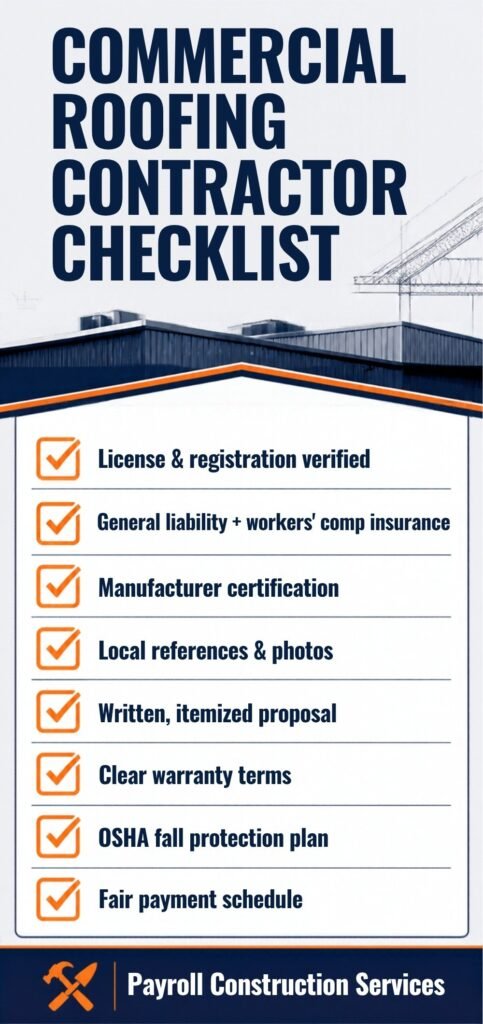
Commercial Roofing Contractor Hiring Checklist
- License and registration verified
- General liability and workers’ comp certificates received
- Manufacturer certifications confirmed
- At least three commercial references checked
- Roof inspection completed before pricing
- Written, itemized proposal received
- Warranty terms reviewed
- Safety plan discussed
- Schedule and disruption plan agreed
- Contract signed with clear payment terms and lien waivers
For Roofing Contractors: Why Payroll and Compliance Matter to Your Customers
If you run a roofing company, building owners are judging you on more than price. Many commercial clients ask for proof of insurance, safety programs, clean financial records and, on public buildings such as schools and government offices, certified payroll at prevailing wages. Roofing contractors with organized payroll, workers’ comp tracking and job costing win more commercial work and avoid costly penalties.
Payroll Construction Services helps roofing contractors with weekly payroll, certified payroll services, construction bookkeeping and construction accounting. Learn more on our services page or contact us for a free consultation.
Frequently Asked Questions
How do I choose a good commercial roofing contractor?
Choose a commercial roofing contractor who is licensed and insured, certified by major roofing manufacturers, experienced with your roof type, has strong local references, provides a detailed written proposal and offers clear manufacturer and workmanship warranties.
What should I look for in roofing contractors near me?
Look for local roofing contractors with a physical office, good Google reviews, verified insurance, commercial experience and fast response times for repairs and warranty calls.
How many quotes should I get from roofing contractors?
Get at least three written proposals from qualified commercial roofing contractors so you can compare scope, materials, warranties and price.
Is the cheapest roofing contractor a good choice?
Not always. Very low bids can mean thinner insulation, missing details or an inexperienced crew. Compare value, not just price.
What insurance should a commercial roofing contractor have?
At minimum, general liability and workers’ compensation insurance, plus commercial auto. Larger jobs often require umbrella coverage. Ask to be listed as an additional insured.
How long does a commercial roof replacement take?
Small projects may take a few days, while large roofs can take several weeks. Weather, roof size, tear-off and material delivery all affect the schedule.
Final Thoughts
Learning how to choose a good commercial roofing contractor protects your building, your budget and your peace of mind. Verify licenses and insurance, check certifications and references, insist on an inspection and a detailed proposal, understand the warranty and choose value over the lowest price. Take your time, compare at least three roofing contractors and hire the one you trust to stand behind the work for years to come.