
Your heating and cooling system keeps your home or business comfortable, safe and healthy all year. When it breaks down or needs replacing, the contractor you hire makes a huge difference. A great HVAC contractor installs the right system, sizes it correctly and stands behind the work. A poor one can leave you with high energy bills, uneven temperatures, repeated breakdowns and a voided warranty.
If you are wondering how to choose a heating and air conditioning contractor, this guide walks you through every step in simple English: what to check, what to ask, how to compare quotes, the red flags to avoid and how to find a trusted HVAC contractor near you.
Why Choosing the Right HVAC Contractor Matters
Heating and air conditioning equipment is expensive, and installation quality matters as much as the brand you choose. Common installation problems such as wrong sizing, poor airflow or an incorrect refrigerant charge can reduce efficiency, raise energy bills and shorten equipment life.
A qualified HVAC contractor helps you:
- Choose the right size system for your building, so it runs efficiently
- Lower energy bills with proper installation and setup
- Protect the manufacturer’s warranty, which often requires professional installation and registration
- Stay safe, since gas furnaces, electrical work and refrigerants all carry risks
- Pass permits and inspections required by your city or county
- Get reliable service when something goes wrong in the middle of winter or summer
Residential vs. Commercial HVAC Contractors
| Residential HVAC contractors | Commercial HVAC contractors | |
|---|---|---|
| Typical buildings | Houses, townhomes, small apartments | Offices, retail, restaurants, schools, warehouses, factories |
| Common equipment | Split air conditioners, heat pumps, furnaces, ductless mini-splits | Rooftop units, chillers, boilers, VRF systems, building controls |
| Project size | One system or a few zones | Many units, large ductwork, complex controls |
| Maintenance | Seasonal tune-ups | Preventive maintenance contracts and service agreements |
| Compliance | Local permits and codes | Codes, engineered plans, and sometimes prevailing wage and certified payroll on public projects |
Make sure the HVAC contractor you hire has experience with your type of building and equipment.
How to Choose a Heating and Air Conditioning Contractor: 10 Proven Tips
1. Check the License
Most states require HVAC or mechanical contractor licenses, and many cities require separate registration or permits. Ask for the license number and look it up on your state licensing board’s website. Make sure it is active and matches the company name on the quote.
2. Confirm Insurance
Ask for certificates showing general liability and workers’ compensation insurance. If a technician is injured on your property and the contractor has no workers’ comp, you could face a claim. Commercial customers should also ask to be named as an additional insured.
3. Look for EPA 608 and NATE Certifications
Technicians who handle refrigerants must hold EPA Section 608 certification, which is required by federal law. Many top technicians also hold NATE certification (North American Technician Excellence), a voluntary industry certification that shows tested knowledge. Ask whether the techs who will work on your system are certified. You can read more about refrigerant rules on the EPA Section 608 page.
4. Ask About Experience and Specialties
Some HVAC contractors focus on new installations, others on repairs, and others on commercial systems. Ask how long the company has been in business, how many systems like yours they install each year, and whether they are trained on the brands they sell.
5. Insist on a Load Calculation
A professional HVAC contractor should size your system using a load calculation, such as ACCA Manual J for homes, instead of simply replacing your old unit with the same size. A load calculation looks at square footage, insulation, windows, sun exposure, air leaks and local climate. An oversized system cycles on and off too often, wastes energy and can leave rooms humid. An undersized system runs constantly and struggles on very hot or cold days.
6. Inspect the Ductwork Too
Even a brand-new system will perform poorly if the ducts are leaky, crushed or the wrong size. A good contractor checks your ductwork and airflow and recommends repairs or sealing when needed.
7. Get Written, Itemized Quotes
Ask at least three HVAC contractors for written quotes. Each quote should list:
- Equipment brand, model numbers and size (tons or BTUs)
- Efficiency ratings, such as SEER2 for cooling, HSPF2 for heat pumps and AFUE for furnaces
- Thermostat or control system included
- Ductwork changes, sealing or new returns
- Electrical, gas line and condensate work
- Removal and disposal of old equipment and refrigerant recovery
- Permits and inspections
- Equipment warranty and labor warranty
- Total price, payment schedule and start date
Model numbers matter. They let you compare quotes fairly and look up efficiency ratings on your own.
8. Understand the Warranties
There are usually two types:
- Manufacturer warranty: covers parts, often for 5 to 10 years, and sometimes longer on compressors or heat exchangers. Many brands require registration within a set number of days after installation to get the full term.
- Labor or workmanship warranty: covers the contractor’s installation work. Terms vary widely, from one year to ten years or more.
Ask who registers the equipment, what is excluded and whether yearly maintenance is required to keep the warranty valid.
9. Check Reviews and References
Read Google reviews and Better Business Bureau ratings, and ask the HVAC contractor for references from recent jobs similar to yours. Look for comments about punctuality, cleanliness, honesty and how the company handled problems. A few negative reviews are normal; the way a company responds is what matters.
10. Ask About Service After the Sale
Heating and air conditioning systems need regular maintenance. Ask about maintenance plans, emergency service hours, average response times and whether they stock common parts. A local HVAC contractor with a strong service department is worth a lot when your heat goes out on a freezing night.
Understanding HVAC Efficiency Ratings
When you compare quotes from heating and air conditioning contractors, you will see several ratings:
| Rating | What it measures | Higher is better? |
|---|---|---|
| SEER2 | Cooling efficiency of air conditioners and heat pumps over a season | Yes |
| EER2 | Cooling efficiency at a hot outdoor temperature | Yes |
| HSPF2 | Heating efficiency of heat pumps | Yes |
| AFUE | Percentage of fuel a furnace turns into heat | Yes |
| ENERGY STAR | Equipment that meets EPA efficiency guidelines | Look for the label |
Federal minimum efficiency standards updated in 2023 now use SEER2 and HSPF2 ratings, and minimums vary by region for central air conditioners. A good HVAC contractor will explain which efficiency level makes sense for your climate, budget and how long you plan to stay in the building. You can compare efficient models on the ENERGY STAR website.
New Refrigerants: What You Should Know
The HVAC industry is moving away from the refrigerant R-410A to newer refrigerants with lower global warming potential, such as R-454B and R-32. New air conditioners and heat pumps are now being made for these refrigerants. When you get quotes, ask:
- Which refrigerant the new system uses
- Whether the technicians are trained on the new refrigerant
- How easily parts and refrigerant can be found for service later
- Whether any matching indoor coil or line set changes are needed
An experienced HVAC contractor will be comfortable answering these questions.
15 Questions to Ask an HVAC Contractor
- Are you licensed and insured in this state, and can I see proof?
- Are your technicians EPA 608 certified? Are any NATE certified?
- How long have you been in business?
- Will you perform a load calculation before recommending a size?
- Will you inspect and test my ductwork?
- Which brands do you install, and why?
- What efficiency ratings does this system have?
- Which refrigerant does it use?
- What is included in the price, and what could cost extra?
- Who pulls the permits and schedules inspections?
- How long will installation take?
- What warranties are included, and who registers the equipment?
- Do you offer maintenance plans?
- What are your emergency service hours?
- Can you provide references from recent customers?
Red Flags When Hiring a Heating and Air Conditioning Contractor
- Quoting by phone without seeing the building. Proper sizing requires an on-site visit.
- Replacing “same size” without a load calculation. Your home or building may have changed since the old system was installed.
- No license or insurance documents.
- Pressure to sign today, or “special pricing” that expires in an hour.
- Very large upfront deposits for the whole job.
- Cash-only deals or offers to skip the permit.
- Vague quotes without model numbers or warranty details.
- Pushing the most expensive system without explaining why you need it.
- Bad-mouthing every competitor instead of explaining their own value.
If you notice these warning signs, keep looking.
How to Compare HVAC Contractor Quotes
Use this simple table to compare quotes side by side:
| Item | Contractor A | Contractor B | Contractor C |
|---|---|---|---|
| Equipment brand and model numbers | |||
| System size (tons or BTUs) | |||
| SEER2 / HSPF2 / AFUE | |||
| Load calculation done? | |||
| Ductwork changes included | |||
| Permit included | |||
| Parts warranty | |||
| Labor warranty | |||
| Maintenance plan offered | |||
| Total price |
The lowest price is not always the best value. A slightly higher quote that includes a load calculation, duct sealing and a longer labor warranty can save you more over the life of the system.
Repair or Replace? What a Good HVAC Contractor Will Tell You
An honest HVAC contractor helps you decide whether to repair or replace. Common factors include:
- Age of the system: many air conditioners and heat pumps last about 10 to 15 years, and many furnaces 15 to 20 years or more
- Repair cost: if a major repair costs a large share of the price of a new system, replacement may make more sense
- Energy bills: rising bills can mean the system is losing efficiency
- Comfort problems: hot and cold spots, humidity or noise
- Safety: cracked heat exchangers or gas leaks require immediate action
Ask the contractor to explain the options in writing, with costs for each, so you can make the decision that fits your budget.
How to Find an HVAC Contractor Near You
Good ways to find a trusted local heating and air conditioning contractor include:
- Recommendations from friends, neighbors, property managers and local businesses
- Google Maps and Google reviews, filtered for your area
- Manufacturer dealer locators, which list trained dealers for each brand
- Industry associations, such as ACCA (Air Conditioning Contractors of America)
- Your utility company, which may list participating contractors for rebate programs
A local HVAC contractor usually responds faster, knows local codes and climate, and depends on a good reputation in your community.
Rebates and Incentives
Many utilities and some states offer rebates for high-efficiency heat pumps, furnaces and smart thermostats. Federal tax credit rules have changed, so ask your HVAC contractor and your tax professional which incentives apply to equipment installed in 2026, and check your utility’s website before you buy. A good contractor will help you with rebate paperwork.
What to Expect on Installation Day
A professional HVAC contractor will usually:
- Arrive on time and review the plan with you
- Protect floors and work areas
- Shut off power and gas safely
- Recover refrigerant from the old system and remove old equipment
- Install the new equipment, line set, thermostat and any duct changes
- Pressure test, evacuate and charge the refrigerant system correctly
- Test airflow, temperatures and safety controls
- Clean up and haul away old equipment
- Show you how to use the thermostat and change filters
- Register the warranty and schedule the inspection
Most simple residential replacements take one to two days. Commercial projects can take longer.
HVAC Maintenance: Protect Your Investment
After installation, regular maintenance keeps your system efficient and your warranty valid. Most HVAC contractors recommend:
- A cooling tune-up every spring for air conditioners and heat pumps
- A heating tune-up every fall for furnaces and heat pumps
- Changing filters every one to three months, depending on the filter and household
- Keeping outdoor units clear of leaves, snow and debris
- Cleaning condensate drains to prevent water leaks
- Commercial preventive maintenance, often quarterly, for rooftop units and larger systems
Many HVAC contractors offer maintenance plans with priority service and discounts on repairs.
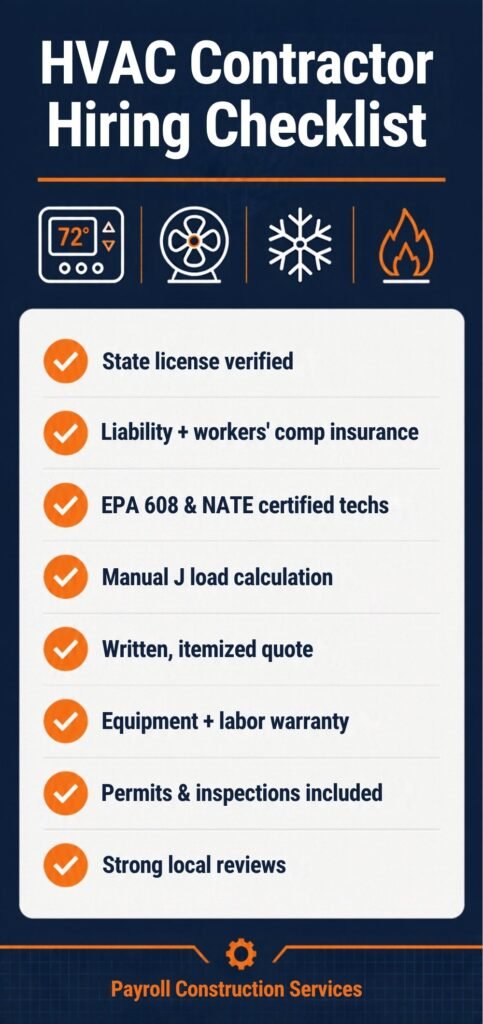
HVAC Contractor Hiring Checklist
- State license verified
- General liability and workers’ comp insurance confirmed
- EPA 608 certified technicians (NATE is a plus)
- Load calculation completed
- Ductwork inspected
- At least three written, itemized quotes compared
- Model numbers and efficiency ratings checked
- Warranty terms and registration explained
- Permits and inspections included
- Reviews and references checked
- Maintenance and emergency service options understood
For HVAC Contractors: Strong Payroll and Books Win More Work
If you own an HVAC company, your customers are checking you just as carefully. Commercial clients often require proof of insurance, safety programs and organized paperwork, and public projects such as schools and government buildings may require certified payroll at prevailing wages. HVAC contractors with accurate payroll, job costing and clean books bid with confidence and avoid costly penalties.
Payroll Construction Services helps HVAC and mechanical contractors with weekly payroll, certified payroll services, construction bookkeeping and construction accounting. Explore our services or contact us for a free consultation. If you are also hiring for a building project, read our guide on how to choose a commercial roofing contractor.
Extra Tips for Commercial Building Owners
If you manage an office, store, restaurant or warehouse, ask your HVAC contractor a few extra questions. Do they offer 24/7 emergency service for business customers? Can they work after hours to avoid disrupting tenants or customers? Do they provide written preventive maintenance reports for each rooftop unit? Can they help plan equipment replacements over several years so you can budget ahead? A commercial HVAC contractor who thinks long term can lower your energy costs and prevent surprise breakdowns during your busiest season.
Frequently Asked Questions
How do I choose a heating and air conditioning contractor?
Choose a licensed and insured HVAC contractor with EPA 608 certified technicians, strong local reviews and experience with your type of system. Make sure they perform a load calculation, provide a written itemized quote with model numbers, and explain the warranties clearly.
How many HVAC quotes should I get?
Get at least three written quotes from qualified HVAC contractors so you can compare equipment, efficiency, warranties and price.
What certifications should an HVAC contractor have?
Technicians who handle refrigerant must be EPA Section 608 certified. NATE certification is a respected voluntary credential. The company should also hold the license required by your state or city.
Should I choose the cheapest HVAC contractor?
Not always. The cheapest quote may skip the load calculation, duct work, permits or quality installation steps. Compare total value, including efficiency and warranties.
How long does it take to replace an air conditioner or furnace?
Most residential replacements take one to two days. Larger homes, ductwork changes or commercial systems can take longer.
What questions should I ask an HVAC contractor before hiring?
Ask about licensing, insurance, certifications, load calculations, equipment model numbers, efficiency ratings, refrigerant type, permits, warranties, maintenance plans and references.
Final Thoughts
Learning how to choose a heating and air conditioning contractor protects your comfort, your safety and your budget. Check licenses and insurance, look for certified technicians, insist on a load calculation, compare itemized quotes and understand the warranties before you sign. The right HVAC contractor will install a system that keeps you comfortable and efficient for many years and will be there when you need service.