
A WIP schedule (work-in-progress schedule) is a monthly report that shows every open construction job, how far along it is, how much revenue you have actually earned, and whether you have billed too much or too little. It is the single most important report in construction accounting, and it is the first thing your surety, bank and CPA ask for.
If your profit and loss statement says one thing and your bank balance says another, a WIP schedule usually explains the gap. In this guide you will learn what goes on a WIP schedule, the formulas behind each column, a complete four-job example, the journal entries it creates, and the red flags bonding companies look for.
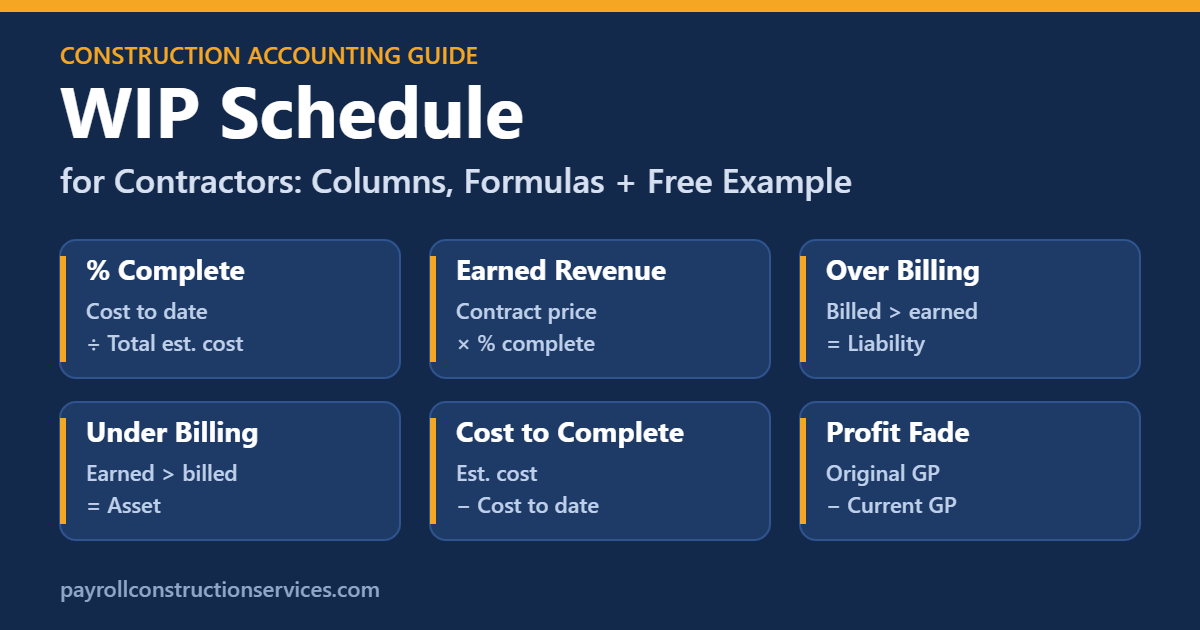
What Is a WIP Schedule in Construction?
Construction jobs run for months, and you bill on a schedule of values, not on the exact work done each day. That means billings and real progress almost never match. A WIP schedule compares the two, job by job, using the percentage-of-completion method.
Each line of the WIP schedule answers four questions:
- How much of this job is finished?
- How much revenue have we really earned so far?
- Have we billed more or less than we earned?
- Is the job still on track to make the profit we bid?
Short version: the WIP schedule turns your billings into earned revenue, and the difference becomes an over billing (liability) or under billing (asset) on your balance sheet.
Why Your WIP Schedule Matters
- Accurate profit: without a WIP schedule, revenue equals billings, so front-loaded billing makes profit look higher than it is.
- Bonding capacity: sureties use your WIP schedule to decide how much work they will bond. Clean, consistent reports can raise your bonding limit.
- Bank covenants: lenders read over billings and under billings to judge cash flow and risk.
- Early warning: profit fade shows up on the WIP schedule months before a job closes, while there is still time to fix it.
- Better bids: real job margins feed back into your estimates and your predetermined overhead rate.
WIP Schedule Columns and Formulas
| Column | What it means | Formula |
|---|---|---|
| Contract price | Original contract plus approved change orders | From contract |
| Total estimated cost | Latest estimate of all costs to finish the job | Cost to date + Cost to complete |
| Estimated gross profit | Expected profit on the full job | Contract price − Total estimated cost |
| Cost to date | All job costs posted, including accruals | From job cost report |
| Percent complete | How far along the job is | Cost to date ÷ Total estimated cost |
| Earned revenue | Revenue you have truly earned | Contract price × Percent complete |
| Billed to date | Total progress billings | From AR / billing |
| Over billing | Billed more than earned | Billed to date − Earned revenue |
| Under billing | Earned more than billed | Earned revenue − Billed to date |
| Cost to complete | Costs still to come | Total estimated cost − Cost to date |
The cost-to-cost method above is the most common way to measure percent complete. Some contractors use units installed or engineer estimates, but cost-to-cost is easiest to audit and is what most sureties expect on a WIP schedule.
WIP Schedule Example: Four Open Jobs
Here is a WIP schedule for a fictional contractor, Ridgeline Builders, as of October 31, 2026.
| Job | Contract | Est. total cost | Cost to date | % complete | Earned revenue | Billed to date | Over / (Under) |
|---|---|---|---|---|---|---|---|
| 101 Oak Street | $500,000 | $400,000 | $160,000 | 40% | $200,000 | $230,000 | $30,000 |
| 102 Mill Plaza | $300,000 | $240,000 | $120,000 | 50% | $150,000 | $120,000 | ($30,000) |
| 103 Cedar Clinic | $850,000 | $722,500 | $578,000 | 80% | $680,000 | $700,000 | $20,000 |
| 104 Pine Remodel | $120,000 | $96,000 | $24,000 | 25% | $30,000 | $25,000 | ($5,000) |
| Total | $1,770,000 | $1,458,500 | $882,000 | $1,060,000 | $1,075,000 | $15,000 net over |
Totals: over billings of $50,000 (Jobs 101 and 103) and under billings of $35,000 (Jobs 102 and 104). Ridgeline is $15,000 net over billed, which is healthy: customers are funding the work slightly ahead of cost.
Checking the Math on Job 103
- Percent complete: $578,000 ÷ $722,500 = 80%
- Earned revenue: $850,000 × 80% = $680,000
- Over billing: $700,000 − $680,000 = $20,000
- Cost to complete: $722,500 − $578,000 = $144,500
Journal Entries from the WIP Schedule
The WIP schedule creates month-end adjusting entries that move revenue from “billed” to “earned.” Most contractors book them gross, one entry for over billings and one for under billings.
Entry 1 – record over billings (Jobs 101 and 103)
| Account | Debit | Credit |
|---|---|---|
| Contract Revenue | $50,000.00 | |
| Billings in Excess of Costs and Estimated Earnings | $50,000.00 |
Entry 2 – record under billings (Jobs 102 and 104)
| Account | Debit | Credit |
|---|---|---|
| Costs and Estimated Earnings in Excess of Billings | $35,000.00 | |
| Contract Revenue | $35,000.00 |
Net effect: revenue drops by $15,000, so the income statement shows $1,060,000 of earned revenue instead of $1,075,000 billed. Reverse these entries on the first day of next month and book fresh ones from the new WIP schedule, or adjust the balances to the new totals.
Profit Fade and Profit Gain
Profit fade happens when a job’s estimated gross profit shrinks over time. A good WIP schedule tracks the original estimate next to the current one so you can see it.
| Job 103 Cedar Clinic | At bid | Oct 31, 2026 |
|---|---|---|
| Contract price | $850,000 | $850,000 |
| Total estimated cost | $680,000 | $722,500 |
| Estimated gross profit | $170,000 | $127,500 |
| Gross margin | 20% | 15% |
| Profit fade | $42,500 |
A $42,500 fade on one job is a signal to review labor productivity, change orders that were never billed, and material price increases. If the WIP schedule ever shows estimated costs above the contract price, record the full expected loss immediately.
How to Build a WIP Schedule Each Month
- Close job costs. Post all payroll, materials and equipment costs, and accrue subcontractor work done but not invoiced.
- Update contract values. Add every approved change order. Leave out unapproved ones, or treat them conservatively.
- Get cost-to-complete from project managers. This is the most important input on the WIP schedule. Old estimates create fake profit.
- Pull billings to date. Include retainage in billings; don’t net it out.
- Calculate each column. Use the formulas above in a spreadsheet or your construction software.
- Book the over and under billing entries. Post them on the last day of the month.
- Review with your team. Look at fade, big under billings and jobs that have not moved.
Modern construction accounting software can generate a WIP schedule automatically, but the cost-to-complete numbers still need a human review every month.
How to Set Up a WIP Schedule Template in Excel or Google Sheets
You do not need expensive software to start. A simple spreadsheet works for most small and mid-size contractors. Set up one row per open job and these columns, left to right:
- Job number and name
- Contract price (original + approved change orders)
- Total estimated cost (from the project manager)
- Estimated gross profit = contract price − total estimated cost
- Cost to date (from the job cost report, including accruals)
- Percent complete = cost to date ÷ total estimated cost
- Earned revenue = contract price × percent complete
- Billed to date (including retainage)
- Over billing = MAX(billed − earned, 0)
- Under billing = MAX(earned − billed, 0)
- Cost to complete = total estimated cost − cost to date
- Gross profit to date = earned revenue − cost to date
Add a total row at the bottom and two check cells: total over billings should equal the “Billings in Excess” balance in your general ledger, and total under billings should equal the “Costs in Excess” balance. If those checks do not match, something was missed in the month-end entries.
Lock the formula columns so only the input columns (contract price, estimated cost, cost to date and billed to date) can be changed. Save a copy each month with the date in the file name. That history becomes your audit trail and makes it easy to spot profit fade from month to month.
Who Should Prepare and Review It?
In most companies the bookkeeper or controller prepares the numbers, but the project managers own the cost-to-complete estimates. The owner should review the final version every month. A 30-minute “WIP meeting” where each PM explains changes on their jobs is one of the best habits a growing contractor can build.
If you do not have a controller in-house, an outsourced construction bookkeeper can collect the PM estimates, build the report, book the entries and walk you through the results. That gives you controller-level reporting without the full-time salary.
WIP Schedule Red Flags Sureties and Banks Watch
| Red flag | Why it worries them |
|---|---|
| Large or growing under billings | Possible cost overruns or slow billing; cash is tied up |
| Heavy over billings on one job | Cash may be used to fund other jobs |
| Profit fade across many jobs | Estimating or field productivity problem |
| Percent complete stuck for months | Estimates are not being updated |
| WIP does not tie to the general ledger | Books cannot be trusted |
| Gross profit jumps at job closeout | Earlier WIP schedules understated costs or revenue |
Common WIP Schedule Mistakes
- Using percent billed instead of percent complete.
- Forgetting accrued subcontractor and payroll costs, which understates percent complete.
- Leaving the original estimate in place for months.
- Including unapproved change orders in contract price.
- Not tying the WIP schedule totals to the balance sheet accounts.
- Only building the WIP schedule at year-end for the CPA.
Strong billing habits also help. Our guide to construction accounts receivable covers billing on time and collecting retainage.
Does a Small Contractor Need a WIP Schedule?
If you have jobs that last more than a month, use progress billing, or need bonding or a line of credit, yes. Even a simple spreadsheet WIP schedule will show you which jobs really make money. Larger contractors are also generally required to use the percentage-of-completion method for long-term contracts on their tax returns; see IRS Publication 538 and talk to your CPA about which method applies to you.
WIP Report vs. Job Cost Report: What Is the Difference?
A job cost report tells you what you have spent on each job by cost code: labor, materials, equipment, subcontractors and overhead. It looks backward. The work-in-progress report takes those same costs, adds your latest estimate of what is left to spend, and uses both to calculate earned revenue and expected profit. It looks forward.
You need both. If the job cost report is wrong, every number on the work-in-progress report is wrong too. That is why accurate coding of timecards, purchase orders and subcontractor pay apps matters so much. Many contractors run the job cost report first, fix miscoded items, and only then roll the numbers forward.
How Change Orders Affect Percent Complete
Change orders change both the contract price and the estimated cost. If you add the extra cost but forget to add the approved change order to the contract, the job looks less profitable than it is. If you add the change order revenue but not the extra cost, the job looks better than it is.
- Approved change orders: add both the revenue and the estimated cost in the same month.
- Pending change orders: include the cost you expect to spend, but only include revenue you are confident you will collect. Many contractors leave pending revenue out completely.
- Disputed change orders: leave the revenue out and note the amount separately so your surety knows about the possible upside.
Example: Job 102 gets an approved $25,000 change order with $20,000 of added cost. Contract price becomes $325,000 and total estimated cost becomes $260,000. With $120,000 spent, percent complete drops from 50% to about 46.2%, and earned revenue becomes roughly $150,000. Small changes like this add up fast across a full backlog.
Where Retainage Fits
Retainage is usually 5% to 10% of each progress bill that the owner holds until the job is finished. On the work-in-progress report, billings to date should include the full billed amount, including retainage, because the retainage is still revenue you have billed. On the balance sheet, retainage receivable is usually shown separately from regular accounts receivable.
Do not reduce billings to date by retainage. Doing that makes every job look under billed and can make your financials look weaker than they really are.
Using Your Backlog Report to Manage Cash Flow
The report is not just for the CPA. Owners and project managers can use it every month to make better cash decisions:
- Bill your under billings. If a job is under billed, check whether you missed billing a completed phase or approved change order.
- Protect your over billings. Cash from over billed jobs is money you still owe in future work. Do not treat it as profit.
- Plan payroll and equipment. Cost to complete tells you how much labor and material is still ahead.
- Know your backlog. Contract price minus earned revenue equals remaining backlog, a key number for bonding and growth planning.
In the example above, Ridgeline has $710,000 of backlog ($1,770,000 contract value − $1,060,000 earned revenue) and $576,500 of costs still to come. That is a quick view of the next few months of work.
The Closed Jobs Schedule
Sureties often ask for a closed jobs schedule along with the open jobs report. It lists jobs finished during the year, with the original estimated profit and the final actual profit. A pattern of jobs that finish close to the original estimate builds trust in your estimating. A pattern of big fades, or big gains at the end, tells the surety your monthly numbers were not reliable.
Keep the closed jobs list in the same spreadsheet or software so you can compare at a glance. It also helps when you look at your overhead rate and markup for next year’s bids.
WIP Schedule Tips From the Field
- Build the WIP schedule on the same business day every month so trends are easy to compare.
- Never let accounting change a PM’s cost-to-complete without a conversation; ownership of the estimate keeps it honest.
- Flag any job where percent complete moved less than 5% in a month but costs kept coming in.
- Show the prior month’s gross profit next to the current one on each line so fade is visible at a glance.
- Share a one-page summary with your surety every quarter, even if they only require it once a year. Regular updates build trust and can help when you need a bigger bond.
These habits take very little time once the WIP schedule template is set up, and they turn the report from a compliance chore into a tool for running the business.
Get a Monthly WIP Schedule Without the Headache
Payroll Construction Services builds your WIP schedule every month, books the over and under billing entries, and ties everything to your balance sheet, so your surety and bank get numbers they trust. See our construction bookkeeping and construction accounting services, or contact us for a free review.
WIP Schedule FAQs
What does WIP stand for in construction?
WIP stands for work in progress. A WIP schedule lists every open job and compares earned revenue to billings using percent complete.
How often should a WIP schedule be prepared?
Monthly is best practice. At minimum, prepare one every quarter and at year-end for your CPA, surety and bank.
Is over billing good or bad?
Moderate over billing is usually healthy because customers are funding the work. Very large over billings can hide cash problems if the money is spent on other jobs.
What is the difference between percent complete and percent billed?
Percent complete is based on costs incurred against total estimated costs. Percent billed is billings divided by contract price. The WIP schedule uses percent complete.
Can I build a WIP schedule in QuickBooks?
QuickBooks does not create a full WIP schedule on its own, but you can export job cost and billing reports to a spreadsheet or use an add-on built for contractors.
Final Thoughts
A WIP schedule is how contractors see the truth about every open job. Update cost-to-complete monthly, calculate percent complete from costs, book over and under billings, and watch for profit fade. Do that consistently and your financials, bonding and bids all get stronger.
Pingback: Over Billing vs. Under Billing: Easy Guide + 3 Proven Examples