
Adjusting entries are journal entries you record at the end of an accounting period so your books show the revenue you actually earned and the expenses you actually incurred in that period, not just the cash that moved. For a contractor, that means catching unpaid crew wages, subcontractor work that hasn’t been invoiced yet, insurance you prepaid months ago, equipment wear, and the over- or under-billing on every open job.
Skip them and your profit and loss swings wildly from month to month, your work-in-progress (WIP) schedule doesn’t tie out, and your bonding agent or lender sees numbers they can’t trust. This guide explains adjusting entries in plain English, walks through the eight types every construction company should know, and gives you real journal entries with dollar amounts you can copy into your own books.
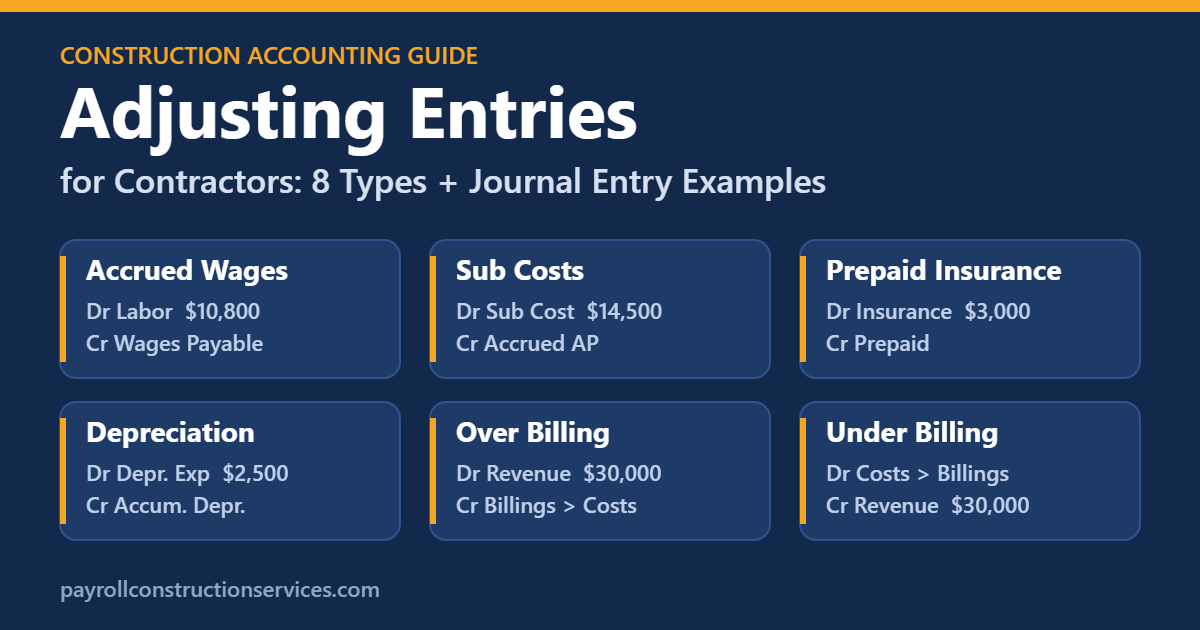
What Are Adjusting Entries in Accounting?
In adjusting entries accounting, the goal is simple: match income and costs to the period they belong to. That idea comes from the accrual basis of accounting and the matching principle. Cash may come in or go out in a different month than the work happens, so at month-end or year-end you “adjust” the books to fix the timing.
Most adjusting entries share three traits:
- They are recorded on the last day of the period (month, quarter or year), before financial statements are prepared.
- They almost never touch the cash account. One side hits the income statement (revenue or expense) and the other hits the balance sheet (an asset or liability).
- They are based on evidence you already have: timesheets, signed subcontractor pay apps, insurance policies, fixed asset schedules and job cost reports.
Simple rule: If the work happened this month but the cash or the invoice shows up next month (or happened last month), you probably need an adjusting entry.
Why Adjusting Entries Matter More for Construction Companies
A retail shop sells a product and is paid the same day. A contractor works on a job for six or eighteen months, bills on a schedule of values, holds back retainage, and pays crews weekly no matter where the month ends. That gap between when work is done and when money moves is exactly what adjusting entries fix.
Without adjusting entries you get problems like these:
- Fake profit spikes: a big progress bill in March makes March look like a record month, even though most of that work was done in February.
- Hidden job losses: subcontractor costs that aren’t invoiced yet make a job look more profitable than it is until it’s too late to fix.
- Bad bids: if job costs are off, your overhead rate and markups are off too. (See our guide on the predetermined overhead rate for how overhead flows into bids.)
- Bonding and bank trouble: sureties and lenders read your WIP schedule closely. Over- and under-billings that aren’t booked are a red flag.
- Tax surprises: if you file on the accrual or percentage-of-completion method, missing adjustments can mean paying tax on the wrong income. Our contractor tax prep team sees this every filing season.
Journal Entry and Adjusting Journal Entry: What’s the Difference?
Every adjusting entry is a journal entry, but not every journal entry is an adjusting entry. A regular journal entry records a transaction when it happens, such as paying a supplier or depositing a customer check. Adjusting journal entries are made at period-end to correct timing, record estimates, or recognize items that no one “transacted” yet.
| Feature | Regular journal entry | Adjusting journal entry |
|---|---|---|
| When it’s recorded | Any day, when the transaction happens | Last day of the period, before reports |
| What triggers it | An invoice, bill, payment or deposit | Time passing, work done, or an estimate |
| Touches cash? | Often | Almost never |
| Accounts affected | Any accounts | One income statement + one balance sheet account |
| Construction example | Paying the lumber yard $8,400 | Accruing $10,800 of crew wages earned but not paid |
| Reversed next period? | No | Sometimes (accruals often are) |
The 8 Types of Adjusting Entries Every Contractor Should Know
Accountants group adjusting entries into accruals, deferrals and estimates. Here is how each one shows up on a construction job, with an example journal entry for a fictional company, “Ridgeline Builders,” closing its books on September 30, 2026.
1. Accrued Wages and Payroll Taxes
Crews are paid weekly or biweekly, so payday rarely lands on the last day of the month. Any days worked but not yet paid must be accrued. If you’re not sure how your pay schedule lines up with month-end, our post on how many pay periods are in a year explains each schedule.
Example: Ridgeline’s field payroll runs $18,000 for a five-day week, paid every Friday. September 30, 2026 is a Wednesday, so Monday through Wednesday (3 days) are earned but unpaid: $18,000 × 3/5 = $10,800. The employer share of Social Security and Medicare is 7.65% (IRS Topic 751), or $826.20.
Adjusting entry – accrued wages (Sept 30)
| Account | Debit | Credit |
|---|---|---|
| Direct Labor – Job Cost | $10,800.00 | |
| Payroll Tax Expense – Job Cost | $826.20 | |
| Accrued Wages Payable | $10,800.00 | |
| Accrued Payroll Taxes Payable | $826.20 |
Charge the labor to the jobs the crew actually worked on so job cost reports stay accurate. Union fringe benefits and workers’ comp premiums based on payroll should be accrued the same way. A dedicated construction payroll service can produce this accrual for you automatically.
2. Accrued Subcontractor and Supplier Costs
Subs often send pay applications days or weeks after the work is done. If the work happened in September, the cost belongs in September.
Example: The electrical sub finished $14,500 of rough-in on the Oak Street job by September 30, confirmed by the superintendent’s daily log, but the pay app won’t arrive until October 10.
Adjusting entry – accrued subcontractor cost
| Account | Debit | Credit |
|---|---|---|
| Subcontractor Costs – Oak Street Job | $14,500.00 | |
| Accrued Subcontractor Costs Payable | $14,500.00 |
This is one of the most common adjusting entries contractors miss, and it directly changes your percentage of completion (see type #7).
3. Prepaid Insurance, Bonds and Permits
Contractors pay large amounts up front: general liability, builder’s risk, auto, performance bond premiums and permit fees. When you pay, the cost is recorded as a prepaid asset. Each month, an adjusting entry moves the used-up part to expense.
Prepaid items are among the easiest adjusting entries to automate. Example: Ridgeline paid a $36,000 annual general liability premium on January 1. Each month, $3,000 ($36,000 ÷ 12) is used up.
Adjusting entry – monthly insurance expense
| Account | Debit | Credit |
|---|---|---|
| Insurance Expense (Overhead) | $3,000.00 | |
| Prepaid Insurance | $3,000.00 |
Bond premiums tied to a single project should go to that job’s cost instead of general overhead.
4. Depreciation of Equipment and Vehicles
Excavators, skid steers, trucks and trailers lose value over their useful lives. Depreciation adjusting entries spread that cost over the years you use them.
Example: An excavator cost $180,000, has an estimated salvage value of $30,000, and a 5-year life. Straight-line depreciation is ($180,000 − $30,000) ÷ 5 = $30,000 per year, or $2,500 per month.
Adjusting entry – monthly depreciation
| Account | Debit | Credit |
|---|---|---|
| Depreciation Expense – Equipment | $2,500.00 | |
| Accumulated Depreciation – Equipment | $2,500.00 |
Book depreciation and tax depreciation are often different. Many contractors use Section 179 or bonus depreciation for taxes; the rules are in IRS Publication 946. Keep both schedules so your books and your return each make sense.
5. Accrued Revenue (Unbilled Work and T&M)
Time-and-materials and service work is often done before it’s invoiced, so it needs adjusting entries too. If you completed $6,200 of T&M repair work on September 28 but won’t invoice until October 3, record it in September.
Adjusting entry – unbilled T&M revenue
| Account | Debit | Credit |
|---|---|---|
| Unbilled Receivables | $6,200.00 | |
| Service Revenue | $6,200.00 |
6. Deferred Revenue (Customer Deposits)
When a homeowner or GC pays a deposit before work starts, that cash is a liability, not income. As work is done, an adjusting entry moves the earned part into revenue.
Example: A remodel client paid a $20,000 deposit in August. By September 30, 25% of the work is complete, so $5,000 has been earned.
Adjusting entry – earned portion of deposit
| Account | Debit | Credit |
|---|---|---|
| Customer Deposits (Deferred Revenue) | $5,000.00 | |
| Contract Revenue | $5,000.00 |
7. Over Billings and Under Billings (WIP Adjustment)
This is the adjusting entry that separates construction accounting from every other industry. Under the percentage-of-completion (cost-to-cost) method, which lines up with revenue recognition under FASB ASC 606, you recognize revenue based on how much of the job’s estimated cost you’ve incurred, not on what you’ve billed.
The formula:
- Percent complete = Costs to date ÷ Total estimated costs
- Earned revenue = Contract price × Percent complete
- Over billing = Billings to date − Earned revenue (when billings are higher)
- Under billing = Earned revenue − Billings to date (when earned is higher)
| Job A – Oak Street | Job B – Mill Plaza | |
|---|---|---|
| Contract price | $500,000 | $300,000 |
| Total estimated cost | $400,000 | $240,000 |
| Costs to date (incl. accruals) | $160,000 | $120,000 |
| Percent complete | 40% | 50% |
| Earned revenue | $200,000 | $150,000 |
| Billed to date | $230,000 | $120,000 |
| Result | Over billed $30,000 | Under billed $30,000 |
Adjusting entry – Job A over billing
| Account | Debit | Credit |
|---|---|---|
| Contract Revenue | $30,000.00 | |
| Billings in Excess of Costs and Estimated Earnings (liability) | $30,000.00 |
Adjusting entry – Job B under billing
| Account | Debit | Credit |
|---|---|---|
| Costs and Estimated Earnings in Excess of Billings (asset) | $30,000.00 | |
| Contract Revenue | $30,000.00 |
Over billings are a liability because you’ve collected (or billed) for work you still owe. Under billings are an asset, but large or growing under billings often signal cost overruns or slow billing, so review them every month. Notice that the $14,500 sub accrual from type #2 is included in costs to date; skip it and your percent complete, and your profit, are wrong.
8. Estimates: Bad Debts, Warranty Reserves and Loss Jobs
Some adjusting entries are judgment calls based on the best information you have:
- Allowance for doubtful accounts: if a customer is 120+ days late and disputing a change order, reserve part of the balance. Strong construction accounts receivable habits keep this small.
- Warranty reserve: if you usually spend about 1% of revenue on callbacks, accrue it as you earn the revenue.
- Provision for loss on a contract: if a job’s estimated costs now exceed the contract price, the full expected loss is recorded right away, not spread over the rest of the job.
Adjusting entry – allowance for doubtful accounts
| Account | Debit | Credit |
|---|---|---|
| Bad Debt Expense | $4,000.00 | |
| Allowance for Doubtful Accounts | $4,000.00 |
What About Retainage?
Retainage (often 5% to 10% held back from each progress payment) usually isn’t an adjusting entry by itself. It should be split out when you bill. But at period-end you should review it and reclassify where needed, for example moving retainage due in more than 12 months to a long-term asset, or recording retainage payable to your subs on the same work. On a $100,000 progress bill with 10% retainage, $90,000 goes to Accounts Receivable and $10,000 to Retainage Receivable.
How to Record Adjusting Entries: A 6-Step Month-End Process
- Close out payroll and time. Pull timesheets through the last day of the month and calculate unpaid days.
- Collect outstanding sub and vendor costs. Ask project managers and supers what work was done but not invoiced.
- Run your recurring entries. Insurance, bond and depreciation amounts are the same every month, so set them up as recurring journal entries in your software.
- Update cost-to-complete estimates. PMs review the estimated cost remaining on every open job.
- Build the WIP schedule and book over and under billings. Calculate percent complete job by job and post the net adjustments.
- Review, reverse and report. Check the trial balance, set accruals to auto-reverse on the first day of next month, then run the P&L, balance sheet and job profitability reports.
Most modern construction accounting software (QuickBooks Online, Sage Intacct, Foundation, Procore integrations) lets you save adjusting entries as templates and mark them as reversing, which saves hours every close.
Should Adjusting Entries Be Reversed?
Reversing entries are optional, but they are very useful for accrual-type adjusting entries. On October 1, you reverse the September 30 accrued wages entry. When the Friday payroll posts the full $18,000, only the October portion ($7,200) stays in October expense. Without the reversal, you’d double-count $10,800 of labor.
A good rule: reverse accruals (wages, sub costs, unbilled revenue). Don’t reverse deferrals and estimates (prepaid insurance, depreciation, allowances), because those are cumulative. Many contractors also reverse and re-book over/under billings each month so the WIP balance always equals the current schedule.
Common Adjusting Entries Mistakes Contractors Make
| Mistake | What it causes | Fix |
|---|---|---|
| Not accruing sub pay apps | Profit looks too high; percent complete is understated | Get a “work done, not billed” list from PMs at every month-end |
| Booking all insurance as expense when paid | January looks terrible; rest of the year looks great | Record as prepaid and expense monthly |
| Skipping the WIP adjustment | Revenue = billings, which hides fade and overruns | Book over/under billings monthly, not just at year-end |
| Forgetting to reverse accruals | Expenses double-counted next month | Use auto-reversing journal entries |
| Posting adjustments to overhead instead of jobs | Job cost reports are wrong; bids get mispriced | Code each accrual to its job and cost code |
| No documentation | Auditors and CPAs can’t support the numbers | Attach timesheets, pay apps and WIP schedules to every entry |
Adjusting Entries on Cash vs. Accrual Basis
If you keep your books on a pure cash basis, you technically don’t make accrual-type adjusting entries; income and expenses are recorded when cash moves. But most growing contractors need accrual books for bonding, bank covenants and job costing, and the IRS generally requires larger contractors to use the accrual or percentage-of-completion method for long-term contracts. Even small cash-basis contractors still record depreciation. If you’re not sure which method fits your company, talk to an accountant who understands construction before you switch.
Adjusting Entries Checklist for Construction Companies
- Accrued field and office wages for unpaid days
- Accrued payroll taxes, union fringes and workers’ comp
- Unbilled subcontractor and supplier costs by job
- Prepaid insurance, bonds, permits and software subscriptions amortized
- Depreciation on equipment, vehicles and tools
- Unbilled T&M and service revenue
- Customer deposits moved to revenue as earned
- Over billings and under billings from the WIP schedule
- Bad debt allowance, warranty reserve and loss-job provisions
- Retainage receivable and payable reviewed and reclassified
- Accruals set to reverse on day one of next period
Let Us Handle Your Month-End Adjusting Entries
Getting adjusting entries right every month takes time most contractors would rather spend on the jobsite. At Payroll Construction Services, we close your books monthly, accrue payroll and sub costs, build your WIP schedule, and book over and under billings so your financials are ready for your banker, surety and CPA. Explore our construction bookkeeping and construction accounting services, or contact us for a free review of your books.
Frequently Asked Questions About Adjusting Entries
What are the 4 main types of adjusting entries?
The four classic types are accrued revenues, accrued expenses, deferred (unearned) revenues, and prepaid (deferred) expenses. Depreciation and estimates such as bad debts are often listed as a fifth group. Construction companies add over and under billings from the WIP schedule.
When are adjusting journal entries made?
Adjusting journal entries are made on the last day of the accounting period, usually month-end, quarter-end or year-end, before the financial statements are prepared.
Do adjusting entries affect cash?
Almost never. Adjusting entries change one income statement account and one balance sheet account, such as wage expense and wages payable. The cash moves later when the bill is paid or the customer pays.
What is the difference between a journal entry and an adjusting journal entry?
A regular journal entry records a transaction when it happens, like paying a vendor. An adjusting journal entry is recorded at period-end to fix timing, so revenue and expenses land in the period they were earned or incurred.
Is over billing an asset or a liability?
Over billing (billings in excess of costs and estimated earnings) is a liability, because you have billed for work you have not yet performed. Under billing is an asset.
Do small contractors need adjusting entries?
Yes, if they keep accrual-basis books, need financial statements for bonding or loans, or want accurate job costing. Even cash-basis contractors record depreciation and should track unbilled costs to see true job profit.
Final Thoughts
Adjusting entries turn a checkbook into real financial statements. For contractors, the big ones are accrued labor, unbilled subcontractor costs, prepaid insurance, depreciation and the WIP over/under billing adjustment. Book your adjusting entries every month, document them, reverse your accruals, and your job profits, bids and bonding capacity will all be built on numbers you can trust.
Pingback: Construction Accounts Receivable: 15 Proven Best Practices (Easy)
Pingback: Accrued Payroll Journal Entry: 6 Easy Steps + Proven Examples
Pingback: Reversing Entries: 6 Easy Steps + Proven Contractor Examples