
Accrued payroll is the wages, payroll taxes and benefits your employees have earned but you have not paid yet at the end of an accounting period. The accrued payroll journal entry records that cost in the month the work happened, even though the paychecks go out later.
For contractors, accrued payroll is one of the biggest month-end numbers. Crews are paid weekly, often a week in arrears, so at any month-end you may owe a full week or more of field labor. Leave it out and your job costs, percent complete and profit are all wrong. This guide shows exactly what to include, how to calculate it, and the journal entries to post, with a full construction example.
What Is Accrued Payroll?
Under accrual accounting, expenses belong to the period in which they are incurred. Labor is incurred when employees do the work, not when you run payroll. Accrued payroll is a current liability on your balance sheet that represents what you owe employees, tax agencies and benefit funds for work already performed.
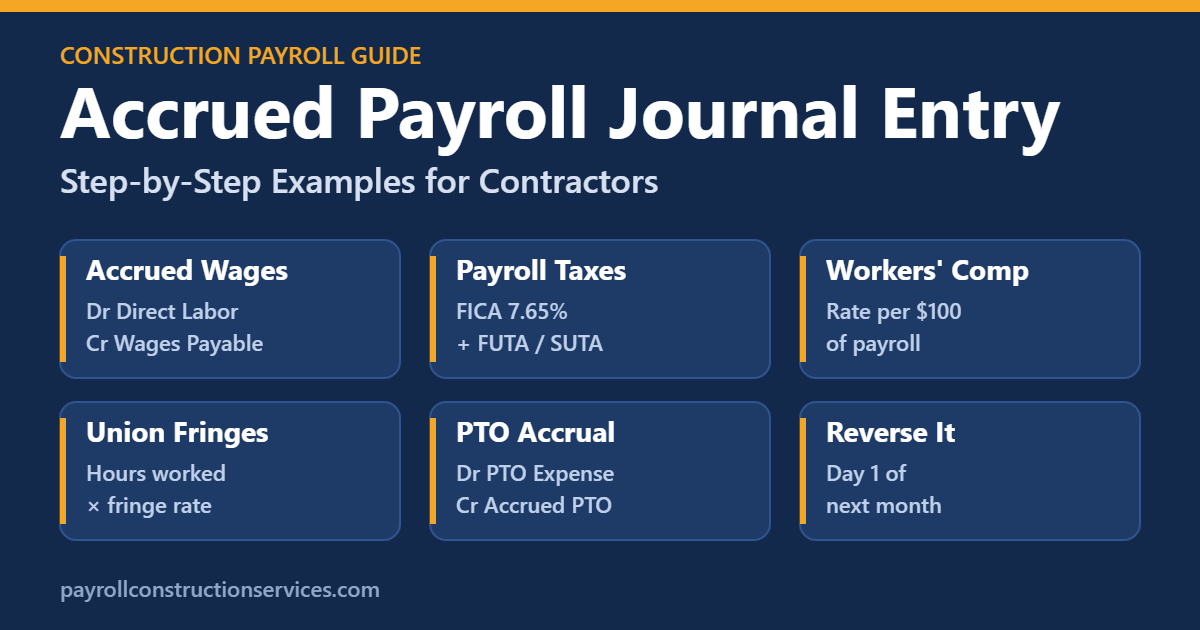
Accrued payroll is one of the most common month-end adjusting entries. It is usually reversed on the first day of the next month so the actual payroll can post normally without double-counting.
What to Include in Accrued Payroll
| Component | What it is | How to estimate it |
|---|---|---|
| Gross wages | Regular and overtime pay for unpaid days | Timesheets or daily crew reports |
| Employer FICA | Social Security 6.2% + Medicare 1.45% | 7.65% of accrued wages (up to the Social Security wage base) |
| FUTA | Federal unemployment tax | Usually 0.6% of the first $7,000 per employee |
| SUTA | State unemployment tax | Your state rate × accrued wages, up to the state wage base |
| Workers’ compensation | Insurance based on payroll and class codes | Rate per $100 of payroll by class code |
| Union fringes | Pension, health, training funds | Hours worked × fringe rate per hour |
| Prevailing wage fringes | Required fringe on public jobs | Hours × required fringe rate |
| Accrued PTO | Vacation or sick time earned, not yet used | Hours earned × pay rate |
| Bonuses | Earned bonuses not yet paid | Bonus plan formula |
Employer FICA rates are set by the IRS; see IRS Topic 751. For more on federal unemployment tax, read our guide to the Federal Unemployment Tax Act (FUTA).
When Do You Need to Accrue Payroll?
You need a payroll accrual any time the last day of your accounting period does not line up with the last day of a paid pay period. That depends on your pay schedule:
- Weekly, paid in arrears: the most common construction setup. You will almost always need to accrue at least one full week plus any days into the next week.
- Biweekly: you may need to accrue up to 13 days, depending on where the month ends.
- Semi-monthly (15th and last day): salaried office staff paid on the last day usually need no wage accrual, but hourly workers on this schedule might.
- Monthly: if you pay on the last day of the month for that month, no accrual is needed.
Not sure how many paychecks you run each year? Our article on how many pay periods are in a year explains every schedule.
How to Calculate Accrued Payroll: Step by Step
- Find the unpaid period. Count the workdays from the end of the last paid pay period through the last day of the month.
- Total the gross wages. Use timesheets, daily reports or your time clock. If those are not final, estimate from the average daily payroll.
- Add employer taxes. Multiply wages by employer FICA, and add FUTA and SUTA for employees who have not hit their wage base.
- Add insurance and fringes. Workers’ comp, union or prevailing wage fringes, and any benefits based on hours.
- Code it to jobs. Charge field labor and labor burden to the correct jobs and cost codes, and office payroll to overhead.
- Post the entry on the last day of the month and set it to reverse on day one of the next month.
Accrued Payroll Journal Entry Example for a Contractor
Ridgeline Builders runs field payroll weekly. The workweek is Monday to Friday, and each week is paid the following Friday. The month ends on Monday, November 30, 2026.
- Week of November 23 to 27: crews worked 4 days (Thanksgiving off). Wages earned: $19,200. Paid Friday, December 4.
- Monday, November 30: 1 day worked. Wages earned: $4,800. Paid Friday, December 11.
- Total accrued wages: $24,000
Now add labor burden:
| Item | Calculation | Amount |
|---|---|---|
| Accrued wages | Timesheets | $24,000.00 |
| Employer FICA | $24,000 × 7.65% | $1,836.00 |
| SUTA | $24,000 × 3.0% (example rate) | $720.00 |
| Workers’ comp | $24,000 ÷ 100 × $6.50 (example rate) | $1,560.00 |
| Total accrued payroll | $28,116.00 |
FUTA is left out here because, by late in the year, most field employees have already earned more than the $7,000 FUTA wage base.
Accrued payroll journal entry – November 30, 2026
| Account | Debit | Credit |
|---|---|---|
| Direct Labor – Job Cost | $24,000.00 | |
| Payroll Tax Expense – Job Cost | $2,556.00 | |
| Workers’ Comp Expense – Job Cost | $1,560.00 | |
| Accrued Wages Payable | $24,000.00 | |
| Accrued Payroll Taxes Payable | $2,556.00 | |
| Accrued Workers’ Comp Payable | $1,560.00 |
Each debit should be split by job and cost code so your WIP schedule picks up the cost in November. That changes percent complete and the over billing vs. under billing position on every job the crew worked.
Reversing the Payroll Accrual
On December 1, post the exact opposite entry:
Reversing entry – December 1, 2026
| Account | Debit | Credit |
|---|---|---|
| Accrued Wages Payable | $24,000.00 | |
| Accrued Payroll Taxes Payable | $2,556.00 | |
| Accrued Workers’ Comp Payable | $1,560.00 | |
| Direct Labor – Job Cost | $24,000.00 | |
| Payroll Tax Expense – Job Cost | $2,556.00 | |
| Workers’ Comp Expense – Job Cost | $1,560.00 |
When the December 4 and December 11 payrolls post normally, the credits from the reversal cancel out the November portion. December only shows December labor, and nothing is counted twice. Without the reversal, you would need to manually split each payroll between the two months.
Accrued Payroll vs. Payroll Payable
These two terms are often confused. Payroll payable (or net pay payable) is created when you actually run payroll and have not yet funded the direct deposits or paid the withheld taxes. Accrued payroll is an estimate of wages and costs earned before payroll has been processed at all.
| Accrued payroll | Payroll payable | |
|---|---|---|
| When created | Month-end, before payroll runs | When payroll is processed |
| Based on | Timesheets or estimates | Final payroll register |
| Includes withholdings? | No, gross wages only | Yes, net pay and withheld taxes are split out |
| Reversed? | Yes, next period | No, cleared when paid |
Accruing PTO and Bonuses
Paid Time Off
If employees earn vacation or sick time that carries over, you have a liability for the time earned but not used. Many contractors with office and salaried staff accrue PTO monthly.
Example: a project manager earns 80 hours of PTO a year (6.67 hours a month) at $45 per hour. The monthly accrual is about $300.
PTO accrual – monthly
| Account | Debit | Credit |
|---|---|---|
| PTO Expense (Overhead) | $300.00 | |
| Accrued PTO Payable | $300.00 |
Unlike the wage accrual, PTO accruals are usually not reversed. Instead, the balance goes down when employees use their time.
Year-End Bonuses
If you promise year-end bonuses based on profit or performance, accrue a portion each month or at least at year-end, before the bonuses are paid in January. This keeps the expense in the year it was earned.
Special Payroll Accruals in Construction
- Union fringe benefits: pension, health and welfare, and apprenticeship funds are usually due monthly based on hours worked. Accrue hours worked through month-end, even if the remittance report is filed later.
- Prevailing wage jobs: fringe amounts on public projects must be tracked for each worker. Accurate accruals also make certified payroll reports easier to tie out.
- Per diem and travel pay: if crews earn per diem on out-of-town jobs, include unpaid per diem in the accrual and charge it to the job.
- Overtime: include overtime hours at the overtime rate. Late-month overtime is often the most expensive part of the accrual.
- Multi-state crews: SUTA and state taxes depend on where the work is done. See our guide to multi-state payroll.
Using a Labor Burden Rate to Speed Up the Accrual
Calculating every tax and insurance line for each accrual takes time. Many contractors use a labor burden rate instead: one percentage that covers employer taxes, workers’ comp, general liability based on payroll, and benefits. You calculate it once a year (or once a quarter) and apply it to accrued wages.
| Burden item | Example rate |
|---|---|
| Employer FICA | 7.65% |
| SUTA (average) | 2.5% |
| FUTA (spread over the year) | 0.4% |
| Workers’ comp (blended) | 6.5% |
| General liability on payroll | 2.0% |
| Health insurance and other benefits | 8.0% |
| Total labor burden | 27.05% |
With a 27.05% burden rate, Ridgeline’s $24,000 of accrued wages would carry $6,492 of burden, for a total payroll accrual of $30,492. True it up each quarter by comparing the burden you applied with the actual taxes and insurance you paid. A burden rate also helps estimators price labor correctly on bids.
Exact Method vs. Estimate Method
There are two ways to calculate the wage portion of the accrual:
- Exact method: pull approved timesheets for every unpaid day and total the actual hours and rates. This is the most accurate and is best when crews are large or overtime is heavy.
- Estimate method: take the average daily payroll from recent weeks and multiply by the unpaid workdays. It is fast and works well when payroll is steady.
Either way, document how you got the number. Attach the timesheet summary or the calculation to the journal entry so your CPA or auditor can follow it.
Where Accrued Payroll Shows Up on Your Financial Statements
On the balance sheet, accrued wages, accrued payroll taxes and accrued benefits are reported as current liabilities, usually grouped as “Accrued expenses” or “Accrued payroll and related liabilities.” On the income statement, field labor and burden flow into cost of revenue (job costs), while office payroll goes to general and administrative expenses.
Because direct labor is often the largest job cost after subcontractors, accruing it properly has a big effect on gross profit. A missing week of field labor on a $5 million contractor can easily overstate monthly gross profit by $50,000 or more.
Year-End Payroll Accruals and Taxes
The December 31 accrual matters most because it affects your tax return. For accrual-basis taxpayers, wages earned in December and paid in January can generally be deducted in the year earned if the liability is fixed and the wages are paid within a short period after year-end (commonly within 2½ months for unrelated employees). Rules differ for owners and related parties, so confirm the treatment with your tax preparer. Our contractor tax prep team reviews year-end accruals as part of every return.
How to Record Accrued Payroll in QuickBooks Online
- Go to + New → Journal entry and set the date to the last day of the month.
- Debit your direct labor and burden expense accounts. Use the Customer/Project column to assign each line to a job.
- Credit the accrued wages, accrued payroll taxes and accrued workers’ comp liability accounts.
- Add a memo, such as “Accrued payroll 11/23–11/30,” and attach your calculation.
- Check Is Adjusting Journal Entry if your version shows it, then save.
- Create the reversing entry dated the first day of the next month. QuickBooks Online Advanced has a reverse option; in other versions you can copy and flip the entry.
Month-End Accrued Payroll Checklist
- Identify the last paid workday and every unpaid workday through month-end.
- Pull approved timesheets or daily crew reports for those days.
- Include regular hours, overtime, double time, per diem and shift differentials.
- Apply employer FICA, FUTA (if under the wage base), SUTA and local payroll taxes.
- Add workers’ comp by class code, plus union or prevailing wage fringes.
- Accrue PTO earned and any bonuses that have been earned.
- Code field labor and burden to jobs and cost codes; code office payroll to overhead.
- Post the entry on the last day of the month with a clear memo and attachment.
- Set up the reversing entry for the first day of the next month.
- After the next payroll posts, compare actual to the accrual and note any large difference.
Following the same checklist every month makes the accrual quick, consistent and easy for your CPA, surety or lender to review. If the actual payroll is regularly far off from your estimate, switch from the estimate method to the exact method, or ask your foremen to submit time daily instead of weekly.
Common Accrued Payroll Mistakes
| Mistake | Result | Fix |
|---|---|---|
| Not accruing the week paid in arrears | November labor shows up in December; job profit is overstated | Always accrue every unpaid workday |
| Accruing wages but not labor burden | Job costs understated by 15–30% | Add taxes, workers’ comp and fringes |
| Posting the accrual to overhead | Job cost reports and WIP are wrong | Code by job and cost code |
| Forgetting to reverse | Labor double-counted next month | Use auto-reversing entries |
| Using last month’s estimate | Accrual does not match real hours | Pull current timesheets every month-end |
How a Construction Payroll Service Helps
A good construction payroll service tracks time by job and cost code, calculates labor burden automatically and gives your bookkeeper a clean accrual report at month-end. For federal payroll tax rules, IRS Publication 15 is the official employer guide.
Accrued Payroll for Salaried and Office Staff
Office managers, estimators, project managers and owners on salary also earn pay every day. If salaried staff are paid biweekly, the month will usually end in the middle of a pay period, so accrue the unpaid days the same way you would for field crews. Divide the biweekly salary by 10 workdays and multiply by the unpaid days.
Example: an estimator earns $3,200 every two weeks. Six workdays are unpaid at month-end, so accrued payroll is $1,920 ($3,200 ÷ 10 × 6), plus employer taxes. Because office salaries are overhead rather than job cost, the debit goes to salaries expense in general and administrative expenses.
If project managers charge time to jobs, split their accrued payroll between job cost and overhead based on their timesheets. This keeps your job profit and overhead rate accurate at the same time.
Let Us Handle Payroll and Month-End Accruals
Payroll Construction Services runs your weekly payroll, accrues wages and labor burden by job at month-end, and books the reversing entries for you, so your job costs and financials are always current. Explore our construction bookkeeping services or contact us for a free consultation.
Accrued Payroll FAQs
Is accrued payroll a liability?
Yes. Accrued payroll is a current liability because it represents wages and related costs your company owes for work already performed.
Do I include employee withholdings in accrued payroll?
No. Accrue gross wages plus employer costs. Employee withholdings like federal income tax are split out only when payroll is actually processed.
Should accrued payroll be reversed?
Yes, wage and tax accruals are usually reversed on the first day of the next period so the real payroll posts without double-counting.
How do I estimate accrued payroll if timesheets are not final?
Use the average daily payroll for the crew multiplied by the unpaid workdays, then true it up next month when actual payroll posts.
Does a cash-basis contractor need to accrue payroll?
Cash-basis books record payroll when paid, so no accrual is recorded. But accrual-basis financial statements, required by most sureties and banks, do need it.
Final Thoughts
The accrued payroll journal entry keeps labor in the month the work was done. Count every unpaid workday, add the full labor burden, code it to jobs, and reverse it on day one of the next month. It takes a few minutes once you have a routine, and it makes every job cost report and WIP schedule more accurate.