
Over billing happens when a contractor has billed a customer for more than the revenue it has actually earned on a job. Under billing is the opposite: you have earned more than you have billed. Both come from the percentage-of-completion method, and both show up on your balance sheet every month.
Knowing the difference between over billing and under billing helps you read your financial statements, protect your cash, and keep your surety and bank comfortable. This guide explains both in plain English, shows how to calculate them, gives real journal entries, and covers what to do when either one gets too large.
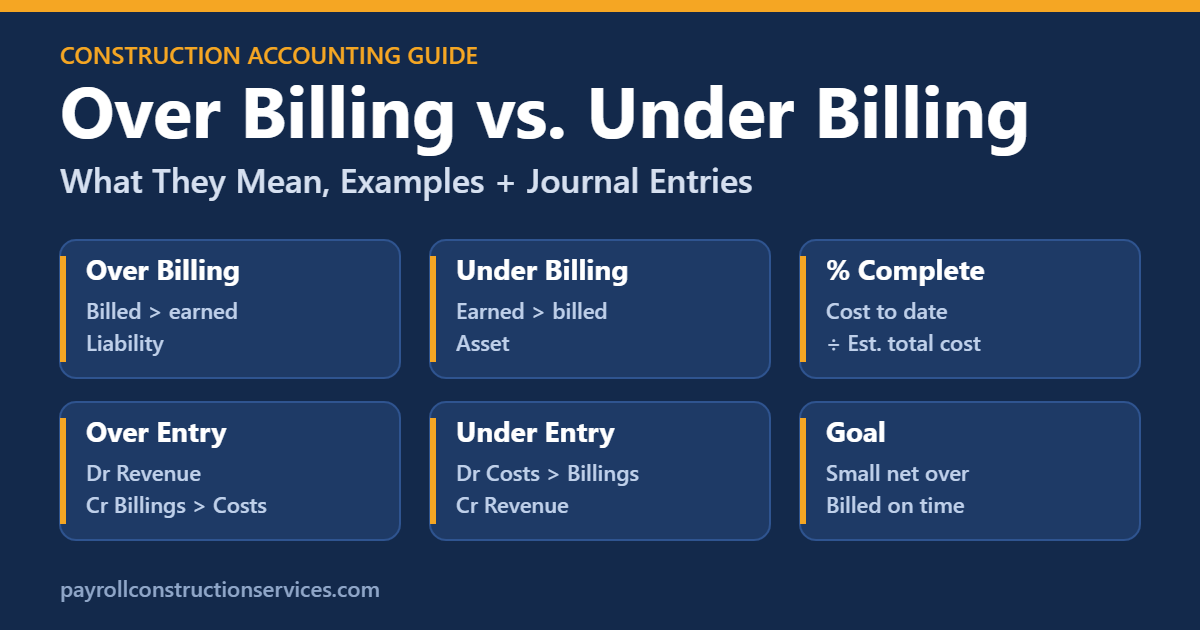
Over Billing vs. Under Billing: Quick Comparison
| Over billing | Under billing | |
|---|---|---|
| Also called | Billings in excess of costs and estimated earnings | Costs and estimated earnings in excess of billings |
| What it means | Billed more than earned | Earned more than billed |
| Balance sheet | Current liability (contract liability) | Current asset (contract asset) |
| Cash effect | Cash comes in ahead of the work | Cash comes in behind the work |
| Typical cause | Front-loaded schedule of values, early mobilization billing | Late billing, unbilled change orders, cost overruns |
| Surety view | Normal in moderation | A warning sign if large or growing |
How Over Billing and Under Billing Are Calculated
Both numbers come from the same three steps on your WIP schedule:
- Percent complete = Cost to date ÷ Total estimated cost
- Earned revenue = Contract price × Percent complete
- Compare to billings: if billed to date is higher, the difference is an over billing. If earned revenue is higher, the difference is an under billing.
Over Billing Example
Job A has a $400,000 contract and $320,000 of total estimated cost. By month-end, $96,000 of cost has been incurred, so the job is 30% complete ($96,000 ÷ $320,000). Earned revenue is $120,000 ($400,000 × 30%). The contractor has billed $150,000. That is a $30,000 over billing.
Journal entry – Job A over billing
| Account | Debit | Credit |
|---|---|---|
| Contract Revenue | $30,000.00 | |
| Billings in Excess of Costs and Estimated Earnings | $30,000.00 |
Under Billing Example
Job B has a $250,000 contract and $200,000 of total estimated cost. Cost to date is $110,000, so the job is 55% complete. Earned revenue is $137,500 ($250,000 × 55%). Only $100,000 has been billed, which leaves a $37,500 under billing.
Journal entry – Job B under billing
| Account | Debit | Credit |
|---|---|---|
| Costs and Estimated Earnings in Excess of Billings | $37,500.00 | |
| Contract Revenue | $37,500.00 |
These are month-end adjusting entries. They do not change what the customer owes you; they only move revenue into the period it was earned.
Why Over Billing Is a Liability
When you over bill, the customer has paid (or owes) you for work you have not yet done. You still have to perform that work, and it will cost you money. Accounting treats the extra billing as an obligation, so over billing is recorded as a current liability. Under ASC 606 it is often called a contract liability.
A common mistake is treating cash from over billed jobs as profit. That cash is really an advance on future costs. If you spend it on overhead, equipment or a different job, you may come up short when the over billed job needs labor and materials later. This is the classic way contractors end up “robbing Peter to pay Paul.”
Why Under Billing Is an Asset
When you under bill, you have done the work and incurred the cost, but you have not sent the invoice yet. You have earned the revenue and expect to bill and collect it, so under billing is recorded as a current asset, often called a contract asset.
The problem is that an under billing is not cash and it is not even a receivable yet. You are financing the job yourself. Sureties and banks look at under billings closely because they can mean one of three things: slow billing, unbilled change orders, or costs running higher than the estimate.
Is Over Billing or Under Billing Better?
In general, a small net over billing position is considered healthy. It means customers are funding your jobs and your cash flow is positive. A large net under billing position is a warning sign because you are paying for the work before you are paid.
That said, neither is “good” in large amounts:
- Excessive over billing can mean front-loaded billing that will catch up with you later, or a percent complete that is too low because the cost estimate is out of date.
- Excessive under billing often means a job is losing money: costs are higher than planned, which pushes percent complete (and earned revenue) up faster than billing allows.
Rule of thumb: many sureties like to see net over billings roughly in line with, or less than, your cash balance. If you are heavily over billed but low on cash, the money has already been spent.
Common Causes of Over Billing
- Front-loading the schedule of values so early line items carry more value than the work.
- Billing mobilization, general conditions or bonds up front.
- Billing stored materials before they are installed.
- A cost estimate that has grown but was never updated, which makes percent complete too low.
- Owner deposits or advance payments on the job.
Common Causes of Under Billing
- Billing late or only once a month on a fixed date after work is done.
- Approved change orders that have not been billed.
- Pending or disputed change orders where the cost is already in the job.
- Cost overruns: labor, materials or subcontractors costing more than estimated.
- Retainage left out of billings to date by mistake.
- Accrued costs booked but billing held until the next draw.
How to Fix Large Under Billings
- Review every under billed job with the PM. Ask what was completed but not billed.
- Bill approved change orders right away. Do not wait for the next pay app cycle if your contract allows it.
- Update the estimate. If costs are over budget, the real issue is profit fade, not billing. Update total estimated cost so the WIP schedule is honest.
- Tighten your billing calendar. Align pay apps with your month-end so billing and costs match.
- Watch collections. Strong construction accounts receivable practices keep cash moving once the bill goes out.
How to Manage Over Billings Safely
- Keep a cash reserve at least equal to your net over billings when possible.
- Do not use over billed cash for distributions or big equipment purchases.
- Update estimates monthly so percent complete is accurate.
- Avoid extreme front-loading on your schedule of values. Owners and architects notice it, and it can hurt your reputation.
Multi-Job Example: Reading the Net Position
Most contractors have several jobs open at once, so what matters is the total picture. Here is a simple three-job summary at month-end.
| Job | Contract | Est. total cost | Cost to date | % complete | Earned | Billed | Over / (Under) |
|---|---|---|---|---|---|---|---|
| A – Warehouse | $400,000 | $320,000 | $96,000 | 30% | $120,000 | $150,000 | $30,000 |
| B – Retail fit-out | $250,000 | $200,000 | $110,000 | 55% | $137,500 | $100,000 | ($37,500) |
| C – School roof | $600,000 | $480,000 | $336,000 | 70% | $420,000 | $445,000 | $25,000 |
| Total | $1,250,000 | $1,000,000 | $542,000 | $677,500 | $695,000 | $17,500 net over |
Total over billings are $55,000 (Jobs A and C), total under billings are $37,500 (Job B), and the company is $17,500 net over billed. That looks fine on the surface, but Job B deserves a closer look. It is the only job behind on billing, and it is more than half done. The next step is to ask the project manager whether a phase or change order was missed, or whether costs are running over budget.
A Real-World Scenario: When Under Billing Hides a Loss
Imagine Job B’s original estimate was $200,000, but the crew is falling behind and material prices went up. The PM now expects the job to cost $240,000. Updating the estimate changes everything:
- New percent complete: $110,000 ÷ $240,000 = 45.8%
- New earned revenue: $250,000 × 45.8% ≈ $114,600
- New under billing: about $14,600 instead of $37,500
- New estimated gross profit: $10,000 instead of $50,000
The large under billing was really a symptom of an outdated estimate. Once the estimate is fixed, the under billing shrinks and the true problem, a $40,000 profit fade, becomes visible. This is why sureties dig into large under billings: they are often the first sign that a job is in trouble.
How Billing Positions Affect Working Capital and Bonding
Sureties use working capital (current assets minus current liabilities) to help set your bonding limit. Because under billings sit in current assets and over billings sit in current liabilities, both directly change working capital.
- Under billings increase current assets, but sureties often discount them, because they are not cash and may not be collectible if a job goes bad.
- Over billings increase current liabilities, which lowers working capital. However, if the matching cash is still in the bank, the effect is neutral.
- Accurate entries make your balance sheet believable. A surety that trusts your numbers is far more likely to grant a higher single-job and aggregate bonding limit.
Schedule of Values Tips to Keep Billings Balanced
Your schedule of values (SOV) decides how much you can bill each month, so it has a huge effect on your billing position. A well-built SOV keeps billings close to actual progress:
- Break large phases into smaller line items so progress is easier to measure.
- Match line items to your cost codes so billing and job costing line up.
- Price general conditions over the life of the job rather than all up front.
- Add separate lines for stored materials and bill them only when the contract allows.
- Update the SOV as soon as a change order is approved.
Month-End Process for Billing Positions
- Post all job costs, including accrued payroll and subcontractor work.
- Have each PM update cost to complete and approved change orders.
- Pull billings to date from your billing or AR system, including retainage.
- Calculate percent complete, earned revenue and the billing position for each job.
- Reverse last month’s entries (or adjust the balances) and post the new over and under billing entries.
- Tie the totals to the balance sheet and review large changes with the team.
Over Billing and Under Billing for Subcontractors
Specialty trade contractors such as electrical, plumbing, HVAC, concrete and roofing face the same issues, often with less control over the billing calendar. A sub usually bills the general contractor on the GC’s pay app schedule, so the cutoff date may not match your month-end. That timing gap alone can create an under billing every single month.
Subcontractors also deal with pay-when-paid clauses, heavier retainage and slow change order approvals. All three push cash further behind the work. If you are a sub, pay close attention to your unbilled change orders and ask the GC to process them on the next draw. Also confirm that your pay app cutoff and your accounting cutoff are documented, so your accountant knows which costs belong to which billing period.
10 Questions to Ask Your Project Managers Each Month
- Has the total estimated cost changed since last month? Why?
- Are there approved change orders that are not in the contract value yet?
- Are there pending change orders with costs already incurred?
- Was any completed work not included on the last pay app?
- Are any subcontractors behind on their invoices?
- Are materials stored on site that have not been billed?
- Is the crew on schedule, ahead or behind?
- Are there any back charges or disputes with the owner?
- When is the next billing, and what will it include?
- Is there any risk this job will finish with a loss?
Writing the answers next to each job on the WIP schedule gives your surety and banker the story behind the numbers, and it keeps everyone focused on the jobs that need help.
Over Billing, Under Billing and Your Financial Statements
On the balance sheet, over billings appear under current liabilities as “Billings in excess of costs and estimated earnings on uncompleted contracts.” Under billings appear under current assets as “Costs and estimated earnings in excess of billings on uncompleted contracts.” The totals must tie to the totals on your WIP schedule.
On the income statement, contract revenue equals billings minus over billings plus under billings. That is why skipping these entries makes revenue and profit swing with your billing schedule instead of with the work.
For tax purposes, many larger contractors must use the percentage-of-completion method for long-term contracts, while smaller contractors may qualify for other methods. IRS Publication 538 explains accounting methods; talk to your CPA about which applies to your company.
Tracking Over and Under Billings in Your Software
Most construction accounting software can produce a WIP report that calculates both numbers automatically from job costs and billings. In QuickBooks Online, many contractors export job cost and billing reports to a spreadsheet, calculate percent complete, and then post one journal entry for each balance at month-end. Either way, the key inputs are accurate job costs and an updated estimate of cost to complete.
Over Billing and Under Billing Warning Signs Checklist
- Net under billings larger than one month of average billings.
- Any single job under billed by more than 10% of its contract value.
- Over billings larger than your cash balance.
- Under billings that grow three months in a row on the same job.
- Percent complete jumping late in a job while billings stay flat.
- Big swings in gross profit at job closeout compared with the last WIP schedule.
If you see two or more of these, review the affected jobs with your project managers before the next billing cycle. Most problems trace back to an outdated estimate, missed change orders or a schedule of values that does not match how the work is really being done. Catching the issue while the job is still active gives you time to bill, negotiate or adjust crews before the over billing or under billing turns into a real loss.
Let Us Track Your Over and Under Billings
Payroll Construction Services builds your WIP schedule, books over and under billings every month, and flags jobs that need attention before they hurt your cash or bonding. Learn more about our construction bookkeeping and construction accounting services, or contact us today.
Over Billing and Under Billing FAQs
Is over billing illegal?
No. In construction accounting, over billing simply means billings are ahead of earned revenue under the percentage-of-completion method. It is normal and expected. Billing for work that was never done or charging improper amounts is a different issue entirely.
Is under billing an asset or a liability?
Under billing is a current asset, often called costs and estimated earnings in excess of billings or a contract asset.
What is net over billing?
Net over billing is total over billings minus total under billings across all open jobs. A positive number means customers are funding your work overall.
Why do sureties care about under billings?
Large under billings can signal cost overruns or slow billing. Both tie up cash and can lead to losses, which increases the risk on bonded work.
How often should over and under billings be recorded?
Every month, using an updated WIP schedule, so your income statement reflects the work actually done.
Final Thoughts
Over billing means you have billed ahead of the work; under billing means the work is ahead of your billing. Calculate both from percent complete, book them monthly, keep a cash cushion for over billings, and dig into every large under billing. That simple habit keeps your profits, cash and bonding on solid ground.