
How Do I Calculate My Salary?
Understanding how your salary converts between hourly, daily, weekly, monthly, and annual pay is essential for budgeting, job comparisons, and payroll accuracy. Many employees and contractors ask questions like “How do I calculate salary per hour?”, “How much is $50,000 a year hourly?”, or “What is $1,200 a week annually?”
At Payroll Construction Services LLC, we regularly help workers, employers, and contractors make sense of these numbers. This guide breaks down all major salary calculations in a clear and practical way, using real examples.
How Do I Calculate My Salary Per Hour?

To calculate your salary per hour from an annual income, you need to know how many hours you work per year.
Standard full-time calculation:
- 40 hours per week
- 52 weeks per year
- Total = 2,080 hours per year
Formula:
Annual Salary ÷ 2,080 = Hourly Rate
Example:
If your annual salary is $50,000:
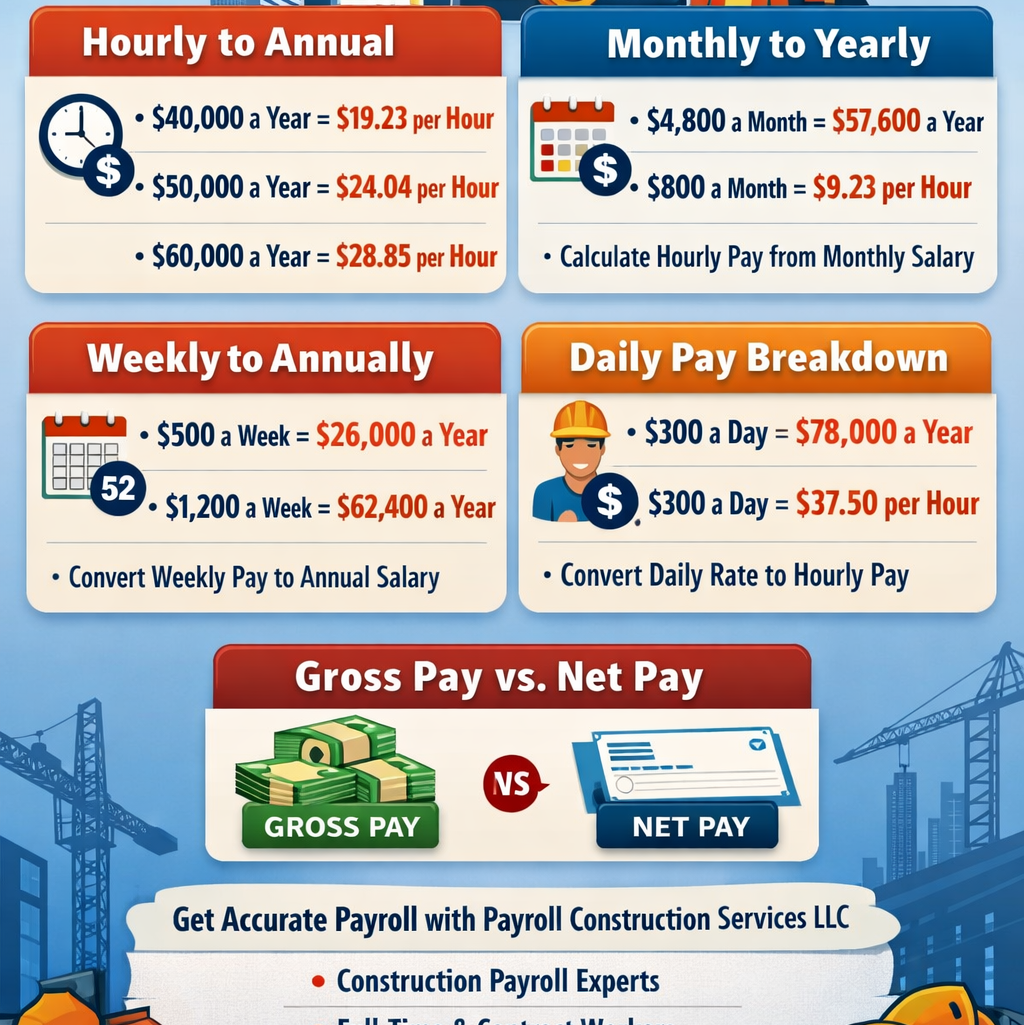
$50,000 ÷ 2,080 = $24.04 per hour
This method works best for full-time employees. If you work part-time or overtime, the hourly rate may differ.
How Do You Calculate Salary Per Day?

To calculate salary per day, you can start from either hourly or annual pay.
From hourly pay:
Hourly Rate × Hours Worked Per Day = Daily Salary
From annual salary:
Annual Salary ÷ 260 working days (5 days × 52 weeks)
Example:
If you earn $25 per hour and work 8 hours a day:
$25 × 8 = $200 per day
Daily salary calculations are especially useful in construction and contract-based jobs where day rates are common.
How Much Is $50,000 a Year Hourly?
A $50,000 annual salary breaks down as follows:
- Hourly: $24.04
- Daily: $192.30
- Weekly: $961.54
- Monthly: $4,166.67
This assumes a full-time schedule of 40 hours per week. Taxes, benefits, and unpaid leave can affect take-home pay, which is why payroll accuracy matters.
How Much Is $60,000 a Year Per Hour?
For a $60,000 annual salary:
$60,000 ÷ 2,080 = $28.85 per hour
This income level is common for skilled trades, supervisors, and mid-level professionals. Employers often use this conversion to ensure compliance with wage laws and overtime calculations.
How Much Is $40,000 a Year Hourly?
A $40,000 yearly salary equals:
$40,000 ÷ 2,080 = $19.23 per hour
This is a useful benchmark for comparing salaried roles with hourly positions, especially in industries with variable schedules like construction and field services.
How Much Is $300 a Day Salary?
If you earn $300 per day and work five days a week:
- Weekly: $1,500
- Annual: $78,000 ($300 × 260 working days)
To calculate hourly pay from a $300 daily salary:
$300 ÷ 8 hours = $37.50 per hour
Daily pay rates are common for contractors and project-based workers.
How Much Is $4,800 a Month a Year?
Monthly salaries are often easier to budget but harder to compare. To convert monthly income to annual salary:
Monthly Salary × 12 = Annual Salary
Example:
$4,800 × 12 = $57,600 per year
This equals approximately:
- $27.69 per hour
- $1,107.69 per week
How Much Is $800 a Month Hourly?
To calculate hourly pay from $800 a month, you must know how many hours are worked.
Assuming 20 hours per week (part-time):
- Monthly hours ≈ 86.7
- $800 ÷ 86.7 = $9.23 per hour
If hours increase or decrease, the hourly rate changes. This is why accurate time tracking is critical for payroll compliance.
What Is $1,200 a Week Annually?
Weekly pay is common in construction and labor-intensive industries.
To calculate annual salary:
Weekly Pay × 52
$1,200 × 52 = $62,400 per year
This equals:
- $30.00 per hour
- $5,200 per month
What Is $500 a Week Annually?
$500 per week equals:
$500 × 52 = $26,000 annually
This income level is often seen in entry-level or part-time positions and is useful for budgeting and tax planning.
What Is My Salary Based on Hourly Pay?
If you know your hourly rate, converting it to an annual salary is simple:
Hourly Rate × Hours Per Week × 52
Example:
$20 per hour × 40 hours × 52 = $41,600 per year
This calculation helps employees compare job offers and understand the real value of their pay.
Gross Pay vs Net Pay: Why It Matters
All calculations above refer to gross pay, which is income before deductions. Net pay is what you actually receive after:
- Federal and state taxes
- Social Security and Medicare
- Benefits and insurance
- Retirement contributions
At Payroll Construction Services LLC, we ensure accurate gross-to-net calculations so workers and employers avoid surprises on payday.
Why Accurate Salary Calculations Are Important
Incorrect salary conversions can lead to:
- Payroll errors
- Overtime disputes
- Tax miscalculations
- Employee dissatisfaction
This is especially critical in construction and trade industries where schedules vary and compliance requirements are strict.
How Payroll Construction Services LLC Can Help
We specialize in:
- Hourly, salaried, and contract payroll
- Construction-specific wage compliance
- Accurate time and pay tracking
- Weekly, bi-weekly, and monthly payroll processing
Whether you are an employer managing a workforce or a worker trying to understand your earnings, our payroll solutions ensure clarity and accuracy. Hope all this has given the answer to” how do I calculate my salary”.
Final Thoughts
Knowing how to calculate your salary per hour, day, week, month, or year empowers you to make better financial decisions. From understanding how much $50,000 a year is hourly to converting $1,200 a week annually, accurate calculations matter.
For professional payroll support tailored to construction and trade industries, Payroll Construction Services LLC is your trusted partner.
Frequently Asked Questions
1. How many paid working days are typically used in salary calculations?
Most payroll calculations assume 260 paid working days per year, based on a 5-day workweek over 52 weeks. This number may change if an employee has unpaid leave, shift work, or a non-standard schedule.
2. Does overtime change my effective hourly salary?
Yes. Overtime pay increases your effective hourly earnings because it is usually paid at 1.5 times or more of your regular rate. However, overtime hours are not always included when calculating base annual salary.
3. Why does my hourly rate look lower when converted from a salary?
Salaried pay is spread across all working hours in a year, including weeks with holidays or reduced workloads. This can make the hourly equivalent appear lower compared to a fixed hourly wage with paid overtime.
4. Should contractors calculate pay differently than salaried employees?
Yes. Contractors typically calculate earnings based on daily or hourly rates, without paid benefits or holidays. This makes accurate pay conversion essential for budgeting taxes, insurance, and project costs.
5. Can payroll errors happen due to incorrect salary conversions?
Absolutely. Incorrect conversions between hourly, weekly, and annual pay can lead to underpayment, tax issues, and compliance risks, especially in construction payroll where work hours often vary.